
Anthropic’s IPO, Part 3: Who Controls Anthropic
Class A holders, from existing investors and staff to new public buyers, will own most of the economic interest but only 49.9% of the vote. A founders’ share, a benefit trust and tiered lock-ups shape the company through 2027.
Updated:

What to know
- Anthropic is a Delaware public benefit corporation, so its directors must balance shareholders’ financial interests against its stated public benefit purpose.
- A single Class F share, held by a company owned by the seven co-founders, carries 50.1% of the vote on general matters. Class A holders, including the new public shareholders, share the remaining 49.9%.
- The founders’ Class F vote has no fixed end date. It lasts until fewer than three continuing founders remain for 90 days in a row, which starts a transition period, or until the founders redeem the share or dissolve the Founder LLC.
- The Long-Term Benefit Trust elects directors who make up a majority of the board.
- Lock-ups are tiered. The last tier, for co-founders and large holders, runs to results for the quarter ending 30 September 2027, or day 365 (18 November 2027) if that comes first.
This report explains public filings and news coverage. It is not investment advice, and it does not forecast the share price.
The timeline: governance and lock-ups
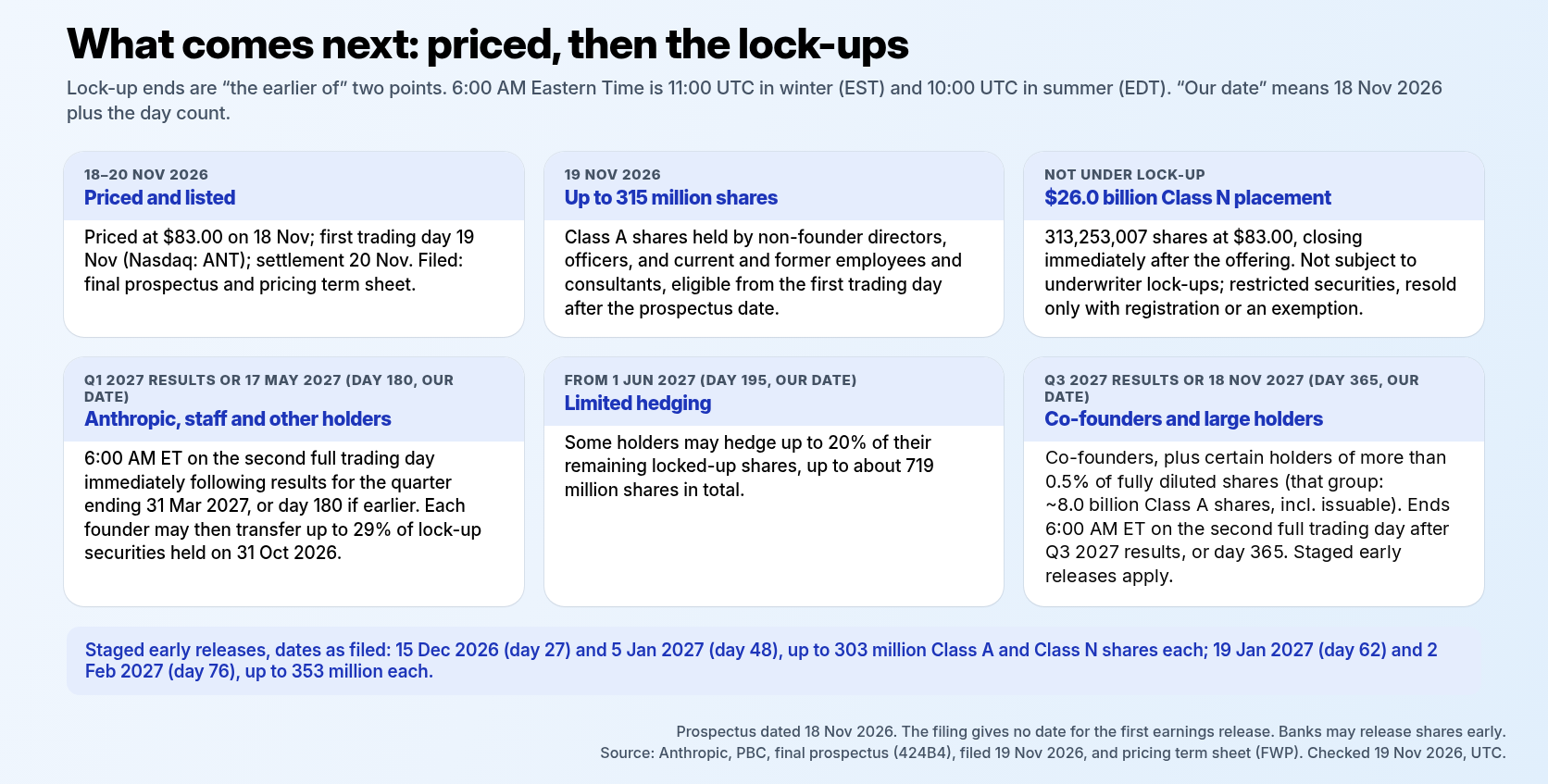
Day counts run from the date of the final prospectus, 18 November 2026. The prospectus gives calendar dates for the early points, and we have converted days 180, 195 and 365 ourselves. The lock-up end points are written as “the earlier of” two events: 6:00 AM ET on the second full trading day immediately following a set of quarterly results, or the close of trading on a numbered day. 6:00 AM ET will be 11:00 UTC if US Eastern Standard Time applies on that date, or 10:00 UTC under daylight time; the UTC time for a results-linked point can be fixed only once the results date is known.
| When | What happens |
|---|---|
| 26 Oct 2026 | The public Form S-1 sets out the share classes and the Long-Term Benefit Trust. |
| 17 Nov 2026 | Amendment No. 3: “We are considered a ‘controlled company’” under Nasdaq governance rules. |
| Just before the offering closes | The single Class F share is issued to the Founder LLC, and Class E is authorized for employees. |
| 18–20 Nov 2026 | 18 Nov 2026: priced at $83.00 a share (filed: pricing term sheet and final prospectus). 19 Nov 2026: first trading day on the Nasdaq Global Select Market as ANT (filed). 20 Nov 2026: expected settlement. |
| Expected 20 Nov 2026 | Immediately after the offering completes, the $26.0 billion Class N private placement, 313,253,007 shares at $83.00, is scheduled to close, subject to its remaining conditions; the final prospectus says the required stockholder approval “we have obtained.” It is not subject to the lock-up or market standoff agreements. |
| 19 Nov 2026 (first trading day after the prospectus date) | Up to 315 million Class A shares held by non-founder directors, officers, and current and former employees and consultants may become eligible for sale. |
| 15 Dec 2026 (day 27), then 5 Jan, 19 Jan and 2 Feb 2027 (days 48, 62 and 76) | Staged early releases for some locked-up large holders, from 6:00 AM ET (11:00 UTC). On 15 December 2026 and 5 January 2027, up to 303 million Class A and Class N shares each may become available; on 19 January and 2 February 2027, up to 353 million each. Further releases are tied to the 2026 annual results, whose date isn’t set. |
| Q1 2027 results, or 17 May 2027 (day 180, our date) if earlier | Anthropic’s own company lock-up ends, as do lock-ups for non-founder directors, officers, employees and consultants, and for certain stockholders holding, in the aggregate, approximately 2.7 billion Class A shares, including shares issuable upon conversion of Class N stock, equity awards and convertible notes, immediately prior to this offering. Up to 3.4 billion additional shares may become eligible before this point. Each founder may transfer up to 29% of their lock-up securities, measured on 31 October 2026. If day 180 comes first, the lock-up ends immediately after the close of trading that day. Google’s registration-rights Restricted Period ends at about the same point: the earlier of the second trading day after the Q1 2027 earnings release and day 180. |
| From 1 Jun 2027 (day 195, our date) | Some holders may hedge up to 20% of their remaining lock-up securities, up to about 719 million shares in total. |
| After Q2 2027 results | Further staged releases for some large holders. |
| Q3 2027 results, or 18 Nov 2027 (day 365, our date) if earlier | The last tier ends: the seven co-founders, and certain stockholders holding more than 0.5% of fully diluted shares before the offering (the filing says certain stockholders in that group hold, in the aggregate, “approximately 8.0 billion shares of our Class A common stock,” including shares issuable upon conversion of Class N stock, equity awards and convertible notes, immediately prior to this offering), subject to the staged early releases. |
Goldman Sachs and Morgan Stanley may release shares from the lock-ups early. The filing gives no date for any quarterly or annual results, so the earnings-linked points cannot yet be dated. The day-count limits can: 17 May 2027, 1 June 2027 and 18 November 2027 (our arithmetic from the 18 November 2026 prospectus date).
A public benefit corporation
Anthropic, PBC is incorporated as a public benefit corporation in Delaware. The filing says: “As a public benefit corporation, we are required to balance the pecuniary interests of our stockholders, the best interests of those materially affected by our conduct, and the specific public benefit purpose identified in our amended and restated certificate of incorporation: the responsible development and maintenance of advanced AI for the long-term benefit of humanity.”
The company has also contributed 846,840,960 Class N shares, representing 5% of its fully diluted shares as of 30 June 2026 (assuming full conversion of the Amazon Notes), to a wholly owned subsidiary, the Anthropic Public Benefit Fund. Its board has approved a framework under which it may, in its discretion, issue to that fund up to a further 2% of then-outstanding shares (plus options, RSUs, other convertible securities, and shares already held by the fund) each time the share price appreciates 50% above the prior share-price milestone, beginning with the IPO price. The co-founders have each pledged to dedicate 80% of their personal equity in Anthropic to philanthropic causes.
Being a PBC gives public shareholders one lever that ordinary shareholders lack. Under Delaware law, as the filing describes it, shareholders of a listed PBC can sue to enforce the board’s duty to balance profit against the public benefit if they own, alone or together, “the lesser of at least two percent of the corporation’s outstanding shares or shares of the corporation with a market value of at least $2,000,000.” At the $97.17 first-day close, $2 million is about 20,600 shares, against about 247 million to 264 million shares for 2%, depending on the share count, so the $2 million test is the one that applies (our arithmetic). The filing lists this as a litigation risk and notes there is “limited judicial precedent” for such suits.
Five share classes
| Class | Economic rights | Vote | Held by |
|---|---|---|---|
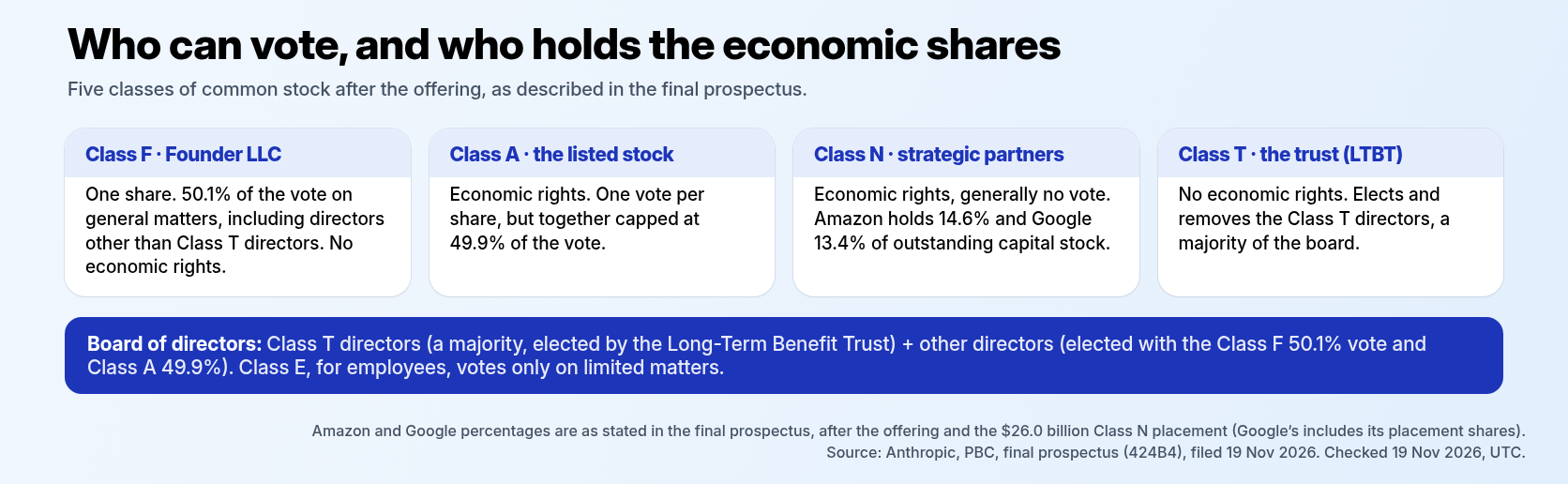
| A | Yes | One vote per share; together limited to 49.9% of the total | Public investors and existing holders; the listed stock, ANT |
| N | Yes | None, except as required by law | “Primarily strategic business partners”; converts to Class A on sale to an unaffiliated third party |
| F | None | One share with 50.1% of the vote on general matters, including electing directors other than Class T directors | The Founder LLC, owned by the seven co-founders |
| T | None | Elects and removes the Class T directors, a majority of the board; no other general vote | The Long-Term Benefit Trust |
| E | None | “Only on certain limited matters” | Employees, excluding the co-founders |
Most of the economic interest sits in Class A, but not with new public buyers alone. After the offering and the placement, the final prospectus counts 7,583,103,996 Class A shares and 5,636,538,278 Class N shares legally outstanding; for accounting purposes the Class N figure is 4,789,697,318, because the 846,840,960 shares held by the Public Benefit Fund are not counted while it holds them. On the legal count Class A is about 57% of the economic shares and the 980,000,000 IPO shares about 7%; on the accounting count, about 61% and 8% (our arithmetic, before the underwriters’ option). The rest of Class A is held by existing investors, employees and others, much of it under the lock-ups below.
The founders’ 50.1%
The Class F share “will be entitled to an aggregate number of votes that equals 50.1% of the total voting power of our outstanding shares of capital stock with respect to matters submitted to stockholders generally, including the election of our directors other than the Class T directors.” Dario Amodei, the chief executive, and Daniela Amodei, the president and board chair, “together with our five other co-founders,” are the initial members of the Founder LLC. If a majority of the continuing founders cannot agree how to vote it, the filing says the Class F share is generally voted in proportion to the Class A votes cast.
The filing’s own conclusion is direct: Class A holders “generally will not be able to affect the outcome of any matter submitted to a vote of our stockholders or the election of our directors, regardless of how they vote,” subject to that exception.
The Class F share has no fixed end date. It stays outstanding until the earlier of two events: the end of a “Class F Transition Period,” which starts once there have been fewer than three Continuing Founders for 90 consecutive days, or the point when no Class F stock is outstanding, for example because a supermajority of the Continuing Founders agrees to redeem it or the Founder LLC is dissolved. The filing calls this the “Class F Sunset Time.” Based on holdings as of 30 September 2026, it says the co-founders will together hold about 11.0% of the general vote through their own shares, and about 61.1% including the Founder LLC. Because the 50.1% is fixed, it is not diluted when Anthropic issues more Class A shares or when Class N converts.
A note on who counts as a co-founder: the filing says Benjamin Mann “is often referred to as a co-founder,” but he “is not a member of the Founder LLC nor a Continuing Founder” and does not take part in deciding how the Class F share votes. References to the seven co-founders in this report follow the filing.
The Long-Term Benefit Trust
In the section on its governance structure, the final prospectus says the trust “is intended to operate as an independent body of five financially disinterested voting trustees (“Trustees”) with expertise in super intelligence safety, national security, public policy, and social enterprise.” Through Class T stock, it “generally has the authority to elect and remove the Class T directors, who together will constitute a majority of the authorized members of our board of directors.” Class T has no economic rights and no other general vote.
The trust’s terms can be changed, but not easily. If the trustees vote in favor, an amendment needs 80% of the board and 80% of the trustees in office. If they do not and the Class F share is still outstanding, there are two routes, and both need a majority of Class A votes cast: until the third anniversary of the offering, all the Continuing Founders plus a majority of Class E (employee) votes cast; or, at any time, two-thirds of the Continuing Founders plus 75% of Class E votes cast. Once no Class F share remains, an amendment the trustees oppose needs 85% of the outstanding Class A shares. The trust’s policies bar trustees from directly buying or holding Anthropic securities, and their pay is a reasonable cash amount fixed each year that does not depend on profits. Class E has one specific role here: if the trust and the board’s nominating and corporate governance committee cannot agree within 15 days on nominating, removing or changing the “Specified Class T Director,” the question can go to a Class E vote.
The board
The board has six directors. The final prospectus lists who will elect each of them after the offering (directors as of 31 October 2026):
- Elected by Class T (the trust): Reed Hastings, the lead independent director; Christopher Liddell, the Specified Class T Director; and Vas Narasimhan.
- Elected by Class A and Class F together: Dario Amodei, Daniela Amodei and Yasmin Razavi.
The filing describes the Class T directors as a majority “of the authorized members” of the board, which counts authorized seats rather than the six directors now serving. Changing the size of the board needs 80% of authorized directors while Class T is outstanding.
Because the trust elects a board majority, Anthropic is a “controlled company” under Nasdaq rules and could skip some governance requirements. The filing says it does “not expect to rely on this exemption except with respect to” its nominating and corporate governance committee, which will not consist entirely of independent directors. It says the board currently has a majority of independent directors, and the audit and compensation committees consist entirely of independent directors.
Amazon and Google
The two largest strategic holders hold non-voting Class N stock. The final prospectus gives their holdings following the completion of the offering and the concurrent private placement, built from share counts as of 30 September 2026 after the conversions at the offering. Google’s figure includes the Class N shares it buys in the placement.
| Holder | Class N shares | Share of Class N | Share of capital stock |
|---|---|---|---|
| Amazon and affiliates | 1,936,452,353 | 34.4% | 14.6% |
| Google LLC | 1,774,959,745 | 31.5% | 13.4% |
Amazon’s convertible notes cannot convert to the extent that Amazon would then hold more than 12% of Anthropic’s capitalization, a cap “Amazon has elected not to waive in connection with this offering.” Without the cap, the filing says, Amazon would hold 3,484,128,662 Class N shares, 48.5% of outstanding Class N and 23.6% of outstanding capital stock; the cap prevents that in this offering. Google is also buying about $10.0 billion of the Class N placement, 120,481,927 shares, which the filing says will reduce its March 2026 note purchase agreement from $20.0 billion to $10.0 billion when the placement closes. Separately, under a July 2026 hardware supply agreement, AMD has committed to purchase up to $5.0 billion of Class N stock, available for Anthropic to draw in increments after specified AMD GPU delivery and deployment milestones. A letter agreement provides that AMD’s purchase in the concurrent private placement will reduce that commitment dollar-for-dollar; after that closing, up to $2.5 billion would remain, available only to the extent the milestone amounts exceed the placement purchase. The filing says the first of those milestones is expected in 2027.
Because Class N carries no general vote, neither company gains voting control from these stakes. Their influence runs through commercial ties: Claude is sold on both companies’ clouds, and both have note purchase agreements that the filing describes as potential future financing.
Why it matters
A business that relies on Claude is buying from a supplier whose public shareholders cannot change its board or its direction by voting. That can be read two ways. The structure is designed to keep safety commitments in place under market pressure. It also means customers and investors have fewer of the usual levers if they disagree; the main one left to public shareholders is the PBC balancing suit described above. The lock-up calendar matters for a different reason: it shows when large blocks of existing shares can start to trade, which the filing itself flags as a risk to the share price.
What comes next
The final prospectus, dated 18 November 2026, has set the day counts above. The first annual and quarterly results after listing will set the earnings-linked points. ANT is now trading; the first-day prices are in the latest update above, and in Part 1. A later part will cover pricing and the first trading day in full.
Sources
- Anthropic, PBC, final prospectus (Form 424B4), dated 18 Nov 2026, filed 19 Nov 2026 (filing index); pricing term sheet (free writing prospectus), dated 18 Nov 2026, filed 19 Nov 2026
- Earlier versions: Anthropic, PBC, Amendment No. 3 to Form S-1, filed 17 Nov 2026 (filing index): prospectus summary, governance structure, description of capital stock, underwriting, and shares eligible for future sale. Form S-1, 26 Oct 2026.
- First-day trading (press reports, not filings): MarketWatch, “Anthropic’s stock blasts out of the gate,” 19 Nov 2026 (first trade, FactSet data); Financial Express, 20 Nov 2026 (time of first trade); CNBC, Anthropic IPO live updates, 19 Nov 2026 (open and close).
Part 1: the deal, as filed · Part 2: inside the numbers · Part 3: who controls Anthropic
Special report · Part 3 · 20 November 2026 · updated 13:30 UTC, 20 November (governance additions and first trade) · filing record through 11:05 UTC, 19 November (final prospectus)