
Anthropic’s IPO, Part 1: The Deal, as Filed
Anthropic, PBC has been approved to list its Class A stock on Nasdaq as ANT. This part sets out what the latest filing actually says about the deal, and what so far appears only in news reports.
Updated:
This is Part 1 of a Special Report series on Anthropic’s initial public offering. Later parts cover the company’s numbers and risk factors, who controls the company, and pricing and the first trading day.
What to know
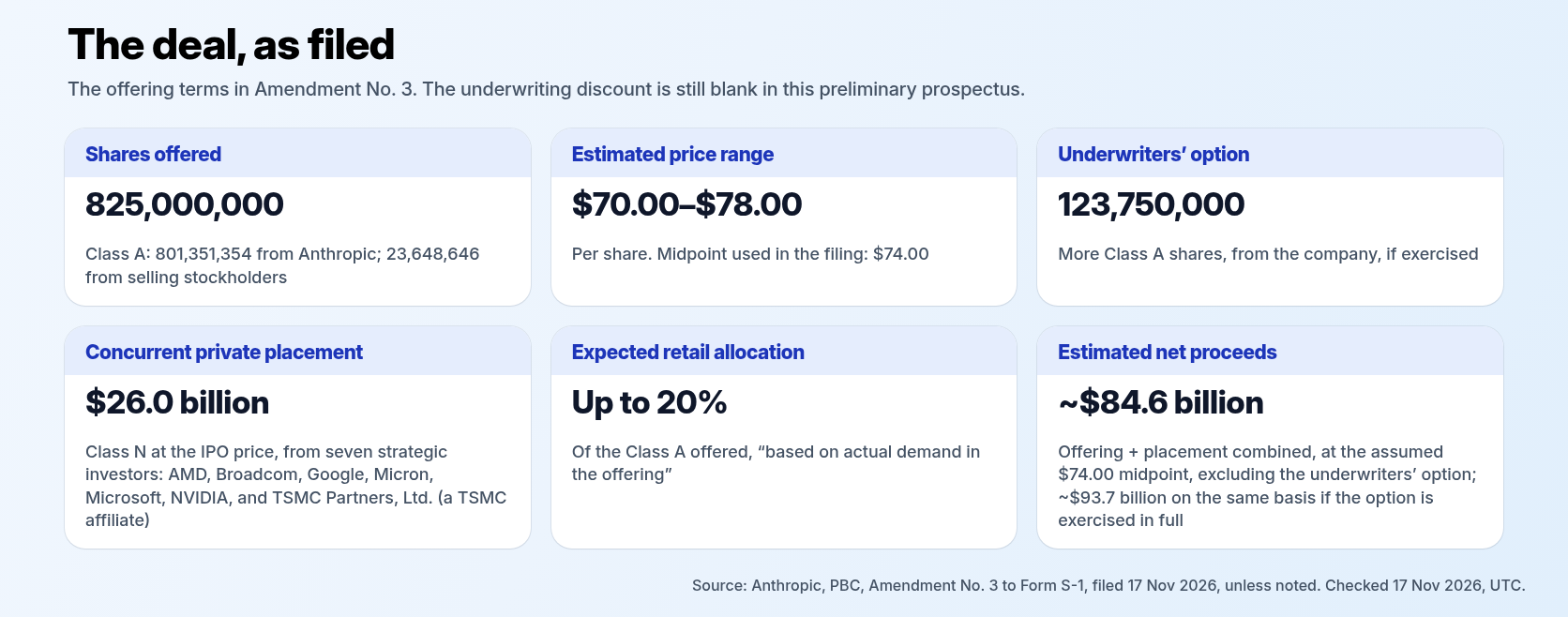
- The proposed offering is 825,000,000 Class A shares at an estimated $70.00 to $78.00: 801,351,354 new shares from Anthropic and 23,648,646 from selling stockholders. Anthropic does not receive the proceeds from the selling stockholders’ shares.
- Seven strategic investors, AMD, Broadcom, Google, Micron, Microsoft, NVIDIA and TSMC Partners, Ltd., an affiliate of TSMC, have agreed to buy $26.0 billion of non-voting Class N stock at the IPO price. The private placement is scheduled to close immediately after the offering, but it depends on the offering being completed and on other conditions, including approval by Anthropic’s stockholders. The offering does not depend on the placement.
- At the assumed $74.00 midpoint, and excluding the underwriters’ option, Anthropic estimates combined net proceeds of about $84.6 billion from the offering and the concurrent private placement. On the same basis, the figure is about $93.7 billion if the option is exercised in full.
- Anthropic does not state a valuation in the filing. By our own calculation, its outstanding Class A and Class N shares, excluding the underwriters’ option, multiplied by the $70 to $78 range give an implied equity value of about $857 billion to $955 billion on the accounting-purpose share count, or about $916 billion to $1,021 billion on the legally outstanding count. The second count also includes 846.8 million Class N shares held by Anthropic’s wholly owned Public Benefit Fund. Separately, CNBC reported a valuation of $1.405 trillion on 16 November without giving its method, and Bloomberg, as reported by Quartz, described roughly $1.4 trillion as a fully diluted figure at the top of the range. Neither press figure appears in the filing, and neither is directly comparable with our outstanding-share calculations.
This report explains public filings and news coverage. It is not investment advice, and it does not forecast the share price.
The timeline so far
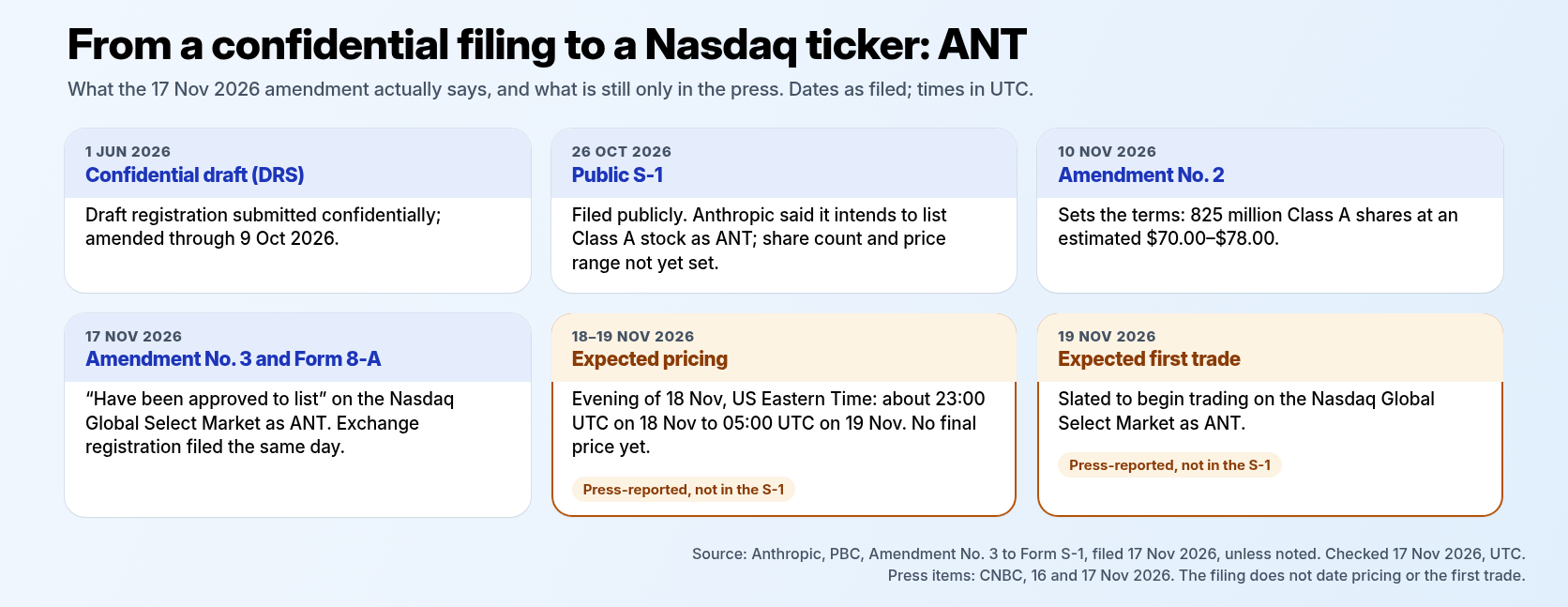
Anthropic went from a confidential draft in June to a third public amendment in November. Dates are as filed. Items marked “press” come from news reports and are not in the filing.
| Date | Filing or event | What it did |
|---|---|---|
| 1 Jun 2026 | Confidential draft registration (DRS) | Submitted confidentially, with amendments through 9 October 2026. |
| 26 Oct 2026 | Form S-1, public | First public filing. Anthropic’s announcement the same day said it “intends to list” its Class A stock on the Nasdaq Global Select Market as ANT, and that the share count and price range had not yet been determined. |
| 2 Nov 2026 | Amendment No. 1 | First public amendment. The price range was still blank. The cover said “We have applied to list” the Class A stock on the Nasdaq Global Select Market as ANT. |
| 10 Nov 2026 | Amendment No. 2 | Set the terms in the preliminary prospectus: 825,000,000 Class A shares at an estimated $70.00 to $78.00. The cover still said “We have applied to list.” |
| 17 Nov 2026 | Amendment No. 3 and Form 8-A | Changed “applied to list” to “have been approved to list.” The Form 8-A registers the Class A stock with the exchange. |
| 17 Nov 2026, 21:00 UTC | Order books close Press | CNBC, citing unnamed sources, reported a plan to close the order books at 4 p.m. ET (21:00 UTC). Not confirmed in any filing. |
| 18 Nov 2026, evening ET | Expected pricing Press | About 23:00 UTC on 18 November to 05:00 UTC on 19 November, according to CNBC. No final price has been filed. |
| 19 Nov 2026 | Expected first trade Press | CNBC reports trading is slated to begin on 19 November. Not stated in the S-1 or the Form 8-A. |
What happened: the offering, as filed
Amendment No. 3 is a preliminary prospectus. Its cover is marked “Subject to Completion. Dated November 17, 2026,” and some numbers, including the underwriting discount, are still blank. It does set out the proposed number of shares and an estimated price range. The final number of shares sold, the final price and the actual proceeds will depend on the completed offering, including whether the underwriters exercise their option to buy more shares. Everything in this section comes from that document unless it says otherwise.
| Term | As filed |
|---|---|
| Issuer | Anthropic, PBC, a Delaware public benefit corporation |
| Security and listing | Class A common stock, approved to list on the Nasdaq Global Select Market under the symbol ANT; trading had not begun at the reporting cutoff |
| Shares offered | 825,000,000 Class A: 801,351,354 from Anthropic, 23,648,646 from selling stockholders |
| Estimated price | $70.00 to $78.00 a share; $74.00 midpoint used throughout the filing |
| Underwriters’ option | Up to 123,750,000 more Class A shares, from Anthropic |
| Total value of the 825 million shares offered | $57.75 billion at $70.00 to $64.35 billion at $78.00 (our arithmetic; includes the selling stockholders’ shares and excludes the private placement) |
| Lead book-runners on the cover | Goldman Sachs & Co. LLC, Morgan Stanley, J.P. Morgan, followed by a long list of other banks |
| Retail | Anthropic “currently expect[s]” retail allocations of “up to 20%” of the Class A offered, in the US and other countries, “though final amounts will be based on actual demand in the offering.” An expected ceiling, not a guaranteed allocation |
| Dividends | “We do not anticipate paying cash dividends in the foreseeable future.” |
Anthropic will not receive money from the selling stockholders’ shares: “We will not receive any proceeds from the sale of shares of our Class A common stock by any of the selling stockholders.” Certain directors and entities affiliated with them have indicated an interest in buying up to $303 million of Class A stock in the offering at the IPO price; the filing says these indications “are not binding agreements or commitments to purchase.” The filing also says, “We are considered a ‘controlled company’” under the Nasdaq Global Select Market’s corporate governance rules; Part 3 of this series covers why.
The $26.0 billion Class N placement
Alongside the public offering, the filing describes a private sale of non-voting Class N stock to seven companies: “We have entered into an agreement with each of Advanced Micro Devices, Inc., Broadcom Inc., Google LLC […], Micron Technology, Inc., Microsoft Corporation, NVIDIA Corporation, and TSMC Partners, Ltd., pursuant to which they have agreed, severally and not jointly, to purchase an aggregate of $26.0 billion of our Class N common stock in a private placement at a price per share equal to the initial public offering price.”
The placement is “contingent upon, and is scheduled to close immediately subsequent to, the completion of this offering as well as the satisfaction of certain conditions.” The filing’s “Concurrent Private Placement” section names one of those conditions: “the receipt of the requisite approval of our stockholders, which we expect to obtain prior to the closing of the concurrent private placement.” The dependency runs one way: “The completion of this offering is not contingent on the completion of the concurrent private placement.” The underwriters receive no discount on these shares. They are not registered in the offering and “will not be subject to lock-up agreements with the underwriters,” but they are restricted securities that can be resold only under a registration statement or an exemption. TSMC Partners, Ltd. is an affiliate of TSMC; the filing refers to it as “TSMC” for short. Google’s share is described separately as $10.0 billion. At the $74.00 midpoint, the filing counts 351,351,348 Class N shares for the placement. The dollar amount is fixed, so the number of shares “will vary inversely with the initial public offering price.” Amazon is not on the list of placement buyers.
Use of proceeds
Anthropic says the offering and the placement are meant “to increase our capitalization and financial flexibility, create a public market for our Class A common stock, facilitate an orderly distribution of shares for the selling stockholders, and enable access to the public equity markets for us and our stockholders.”
It intends to use the money for “general corporate purposes, including working capital, operating expenses, and capital expenditures, including investments in compute and infrastructure, as well as hiring and retention of highly skilled personnel.” It may use some for acquisitions or investments, but says it has no agreements or commitments for any material ones. A portion will cover about $3.8 billion of tax withholding tied to the settlement of restricted stock units, a figure based on the $74.00 midpoint.
Not all of the money raised in the offering goes to Anthropic. Anthropic does not receive the proceeds from shares sold by existing stockholders. The table below splits the offering at the $74.00 midpoint, excluding the underwriters’ option.
| Component | Amount |
|---|---|
| Total value of the 825,000,000 Class A shares offered | $61.05 billion |
| Sold by Anthropic: 801,351,354 new shares, gross | $59.30 billion |
| Sold by selling stockholders: 23,648,646 shares, paid to them, not to Anthropic | $1.75 billion |
| Class N private placement: 351,351,348 shares, paid to Anthropic, no underwriting discount | $26.00 billion |
| Anthropic’s gross proceeds, offering and placement combined | $85.30 billion |
| Anthropic’s estimated net proceeds, as stated in the filing | About $84.6 billion |
Net proceeds are not the same as gross proceeds. The filing’s $84.6 billion is after “estimated underwriting discounts and commissions,” which apply only to the Class A shares Anthropic sells, and “estimated offering expenses payable by us.” By our arithmetic, those deductions come to roughly $0.7 billion; the filing does not yet state the underwriting discount itself. The filing also says each $1.00 change in the assumed price would change net proceeds by about $793 million. Only the Class A part moves: the placement is a fixed $26.0 billion, so at a different price it buys a different number of Class N shares.
| Item | Amount |
|---|---|
| Estimated net proceeds, offering and placement combined, at the assumed $74.00 midpoint, excluding the underwriters’ option | About $84.6 billion |
| The same basis, with the underwriters’ option exercised in full | About $93.7 billion |
| Cash, cash equivalents, and short-term investments, actual, as of 30 Sep 2026 | $131.845 billion |
| The same line, pro forma as adjusted for the offering and placement at $74.00: an illustrative figure, not cash held on 30 Sep 2026 | $212.684 billion |
| RSU tax withholding to be paid from proceeds, at $74.00 | $3.8 billion |
Different figures for what Anthropic is worth
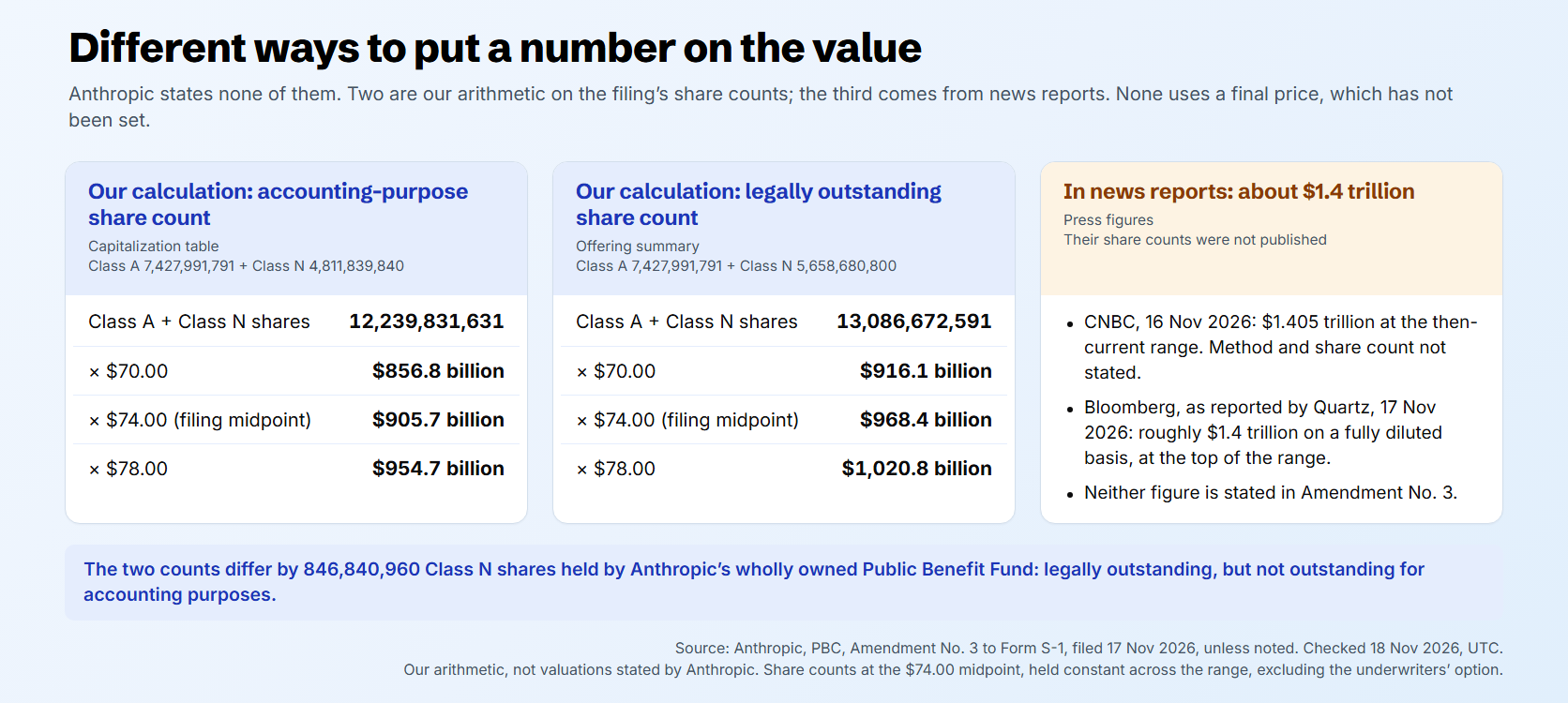
Anthropic does not state an equity valuation in Amendment No. 3. Our own calculations use share counts disclosed in the filing. Separately, CNBC reported a valuation of about $1.405 trillion, and Bloomberg, as reported by Quartz, described roughly $1.4 trillion on a fully diluted basis. These figures do not rest on the same share count, and the press figures’ counts were not published, so they are not directly comparable. None of them uses a final price, because none has been set.
Understanding Anthropic’s outstanding-share counts
Amendment No. 3 gives two different share counts that matter for a simple equity-value calculation. Both cover only Class A and Class N, the two classes with economic rights. The filing says Class N has “economic rights equivalent to those of our Class A common stock,” while Classes T, F and E have no economic rights and are not entitled to dividends.
- Accounting-purpose count. The pro forma as adjusted capitalization table shows 7,427,991,791 Class A shares and 4,811,839,840 Class N shares outstanding, or 12,239,831,631 combined.
- Legally outstanding count. The offering summary shows 7,427,991,791 Class A shares and 5,658,680,800 Class N shares outstanding after the offering and the placement, or 13,086,672,591 shares with economic rights. Adding the single Class T share and the single Class F share (there are no Class E shares) gives the summary’s total of 13,086,672,593.
The difference is 846,840,960 Class N shares that Anthropic contributed to the Anthropic Public Benefit Fund, its wholly owned subsidiary, in what the filing calls the Initial Public Benefit Issuance. The filing says those shares “are considered legally outstanding” but “are not considered outstanding for accounting purposes while held by our wholly owned subsidiary.” Neither count is the right basis for every purpose, so we show both.
Both counts are calculated at the $74.00 midpoint and exclude the underwriters’ option. Multiplied by the price range, they give the figures below. These are our calculations, not valuations stated by Anthropic, and neither is a reconstruction of the figures in news reports.
| Assumed price | Accounting count | Legal count |
|---|---|---|
| $70.00 | 856.8 | 916.1 |
| $74.00 (filing midpoint) | 905.7 | 968.4 |
| $78.00 | 954.7 | 1,020.8 |
If the underwriters’ option were exercised in full, the filing says Class A outstanding would be 7,551,741,791. At $78.00 that would put the figure at about $964.4 billion on the accounting-purpose count and about $1,030.4 billion on the legally outstanding count.
This arithmetic has two limits. First, it holds the share counts fixed, but the filing calculates them at $74.00. The $26.0 billion placement buys more Class N shares at a lower price and fewer at a higher one: about 371.4 million at $70.00 and 333.3 million at $78.00, against 351.4 million at $74.00. Recalculating that one count moves both $70.00 figures up by about $1.4 billion, to about $858.2 billion and $917.5 billion, and both $78.00 figures down by about $1.4 billion, to about $953.3 billion and $1,019.4 billion. Second, both counts include only shares outstanding after the offering. They leave out options, unvested restricted stock units, shares reserved for future issuance, and possible future issuances, such as the further Class N shares, up to an additional 2%, that the board may issue to the Public Benefit Fund under a framework tied to future share-price increases.
In news reports. CNBC wrote on 16 November that at the current range the offering “would bring in more than $64 billion, giving the company a valuation of $1.405 trillion.” CNBC did not say how it calculated that figure or which share count it used, and we have not been able to establish its method. Separately, Bloomberg, as reported by Quartz on 17 November, described a figure of “roughly $1.4 trillion on a fully diluted basis” at the top of the range. We have not assumed that CNBC and Bloomberg used the same method. Neither the CNBC figure nor the Bloomberg figure appears in Amendment No. 3. A fully diluted count usually adds shares that do not exist yet, such as options and unvested stock awards, and sometimes shares reserved for future grants.
A broad potential-share scenario. Outside both counts, the filing lists 1,774,342,693 Class A options, with a weighted-average exercise price of $2.91, and 1,026,660,010 unvested restricted stock units. It also lists 2,982,317,615 shares reserved, or to be reserved, for future issuance: 1,920,580,692 under the 2026 equity incentive plan, 128,038,713 under the employee stock purchase plan, and 933,698,210 Class N shares under a donation-matching plan, as of 30 September. The table below adds these in steps, at $78.00. The last row includes shares that have not been granted or issued to anyone, so it is an illustrative scenario, not a conventional fully diluted valuation, and it does not reproduce CNBC’s or Bloomberg’s method. It counts options in full, without deducting their roughly $5.2 billion of exercise proceeds. It leaves out smaller items, and up to 3.4 billion shares that could move into the new equity plan from the old one, which would partly double-count awards already listed.
| Shares counted | Accounting count | Legal count |
|---|---|---|
| Outstanding Class A and Class N | 954.7 | 1,020.8 |
| Plus options and unvested RSUs (2.80 billion shares) | 1,173.2 | 1,239.2 |
| Plus shares reserved for future issuance, not yet granted or issued (2.98 billion shares) | 1,405.8 | 1,471.9 |
The filing’s only use of “fully diluted” for the company’s share count is indirect. It says the 846,840,960 Public Benefit Fund shares represented 5% of its fully diluted shares as of 30 June 2026, assuming full conversion of the Amazon notes. That implies about 16.9 billion shares at that date, before the offering and the placement.
Proceeds are a third, separate number. The 825 million shares would raise $57.75 billion to $64.35 billion across the range, before the $26.0 billion placement; about $1.66 billion to $1.84 billion of that would go to the selling stockholders, not to Anthropic. That is money coming in, not the value of the company.
Press-reported demand, not confirmed
Some reports concern demand for the shares. Bloomberg, on 11 November, reported the offering as multiple times oversubscribed. On 12 November, Bloomberg reported that the offering had drawn “about six times the orders for the shares available,” citing people familiar with the matter, and that bankers had told prospective investors that existing backers would be prioritized. Reuters carried Bloomberg’s report the same day, saying this could leave “some would-be buyers with smaller allocations than expected” and that details, including demand, could change. On 17 November, Quartz, citing Bloomberg, reported orders of “almost seven times” the stock on offer. The six-times and seven-times figures are different press estimates, possibly from different points in the book-building, and Anthropic has confirmed neither. CNBC reported on 17 November, citing unnamed sources, that Anthropic is likely to price above the $70 to $78 range. These are press-reported order-book indications, not figures in the filing. Orders in a book are not binding, and oversubscription does not guarantee an allocation, a final price or how the shares will trade. No final price had been filed at the time of writing.
Why it matters
For companies that buy Claude, the listing means much more visibility into their supplier. The filing says that “as a result of this offering,” Anthropic will become subject to the reporting requirements of the Securities Exchange Act and “will file periodic reports, proxy statements, and other information with the SEC.” For a US-listed company, that means annual reports on Form 10-K, with audited financial statements, and quarterly reports on Form 10-Q. Its risk disclosures are already long: the risk-factor section in Amendment No. 3 runs to more than 90 pages, ending on page 124 of the filing’s own pagination. Anthropic says it will use the proceeds for general corporate purposes, including compute, infrastructure and hiring. The filing announces no change to Claude’s pricing, and this report doesn’t assume one.
The gap between our filing-based figures and the press figures is a lesson in reading a vendor’s filing: separate what the company states from what others say about it, and check which share count any value figure uses. The share counts, offering terms and proceeds estimates are filed facts. The roughly $1.4 trillion valuation, the reported order-book demand and the expected pricing date come from press reports, not the filing.
What comes next
The next document to watch is the final prospectus, filed after pricing. It should give the final price, the final number of shares and the underwriting discount. Today the price is an estimated range, the share count is the proposed number, and the discount is blank. The arithmetic above can then be redone at the actual price. Actual proceeds will also depend on whether the underwriters exercise their option to buy more shares.
Part 2 (coming soon) of this series looks at the numbers inside the filing: revenue, the gap between the operating loss and the net loss, compute commitments, and the risk factors. Part 3 (coming soon) covers who controls the company after the listing, and when the lock-up periods end.
Final price and first-day trading
Anthropic is expected to price the offering on 18 November and begin trading as ANT on 19 November, according to CNBC. We will update this section with the final price and first-day trading.
Sources
- Anthropic, PBC, Amendment No. 3 to Form S-1, filed 17 Nov 2026 (filing index). Primary source for all terms, quotes and share counts.
- Anthropic, PBC, Form 8-A, filed 17 Nov 2026; Form S-1, 26 Oct 2026; Amendment No. 1, 2 Nov 2026; Amendment No. 2, 10 Nov 2026; EDGAR filing list
- The Nasdaq Stock Market LLC, certification of approval for listing (CERT), filed 18 Nov 2026, 14:12 UTC, after the reporting cutoff
- Anthropic, “Anthropic files S-1 with the SEC for proposed initial public offering”, 26 Oct 2026
- CNBC, “Anthropic IPO guide: The price range, date and more”, 16 Nov 2026, and “Anthropic likely to price IPO above the current range of $70 to $78, sources tell CNBC”, 17 Nov 2026
- Bloomberg, Bailey Lipschultz, “Anthropic’s IPO Is Said to Be Multiple Times Oversubscribed”, Bloomberg Law, 11 Nov 2026, 14:41 UTC, and “Anthropic’s IPO Is Said to Be About Six Times Oversubscribed”, Bloomberg Law, 12 Nov 2026, 21:00 UTC
- Reuters, “Anthropic’s IPO is about six times oversubscribed, Bloomberg News reports”, 12 Nov 2026, reporting Bloomberg’s account
- Quartz, “Anthropic is guiding its IPO price to the top of its range or above”, 17 Nov 2026, citing Bloomberg
Part 1: the deal, as filed · Part 2: inside the numbers (coming soon) · Part 3: who controls Anthropic (coming soon)
Special report · Part 1 · 17 November 2026 · reporting cutoff 12:00 UTC, 18 November · editorial updates 14:01 and 14:50 UTC, 18 November