
Anthropic’s IPO, Part 2: Inside the Numbers
Revenue grew fast. Most of the $104 billion net loss is accounting charges, the operating loss is far smaller and briefly turned into a profit in the second quarter, and the compute commitments are very large. Here is what the filing reports, in its own words.
Updated:

What to know
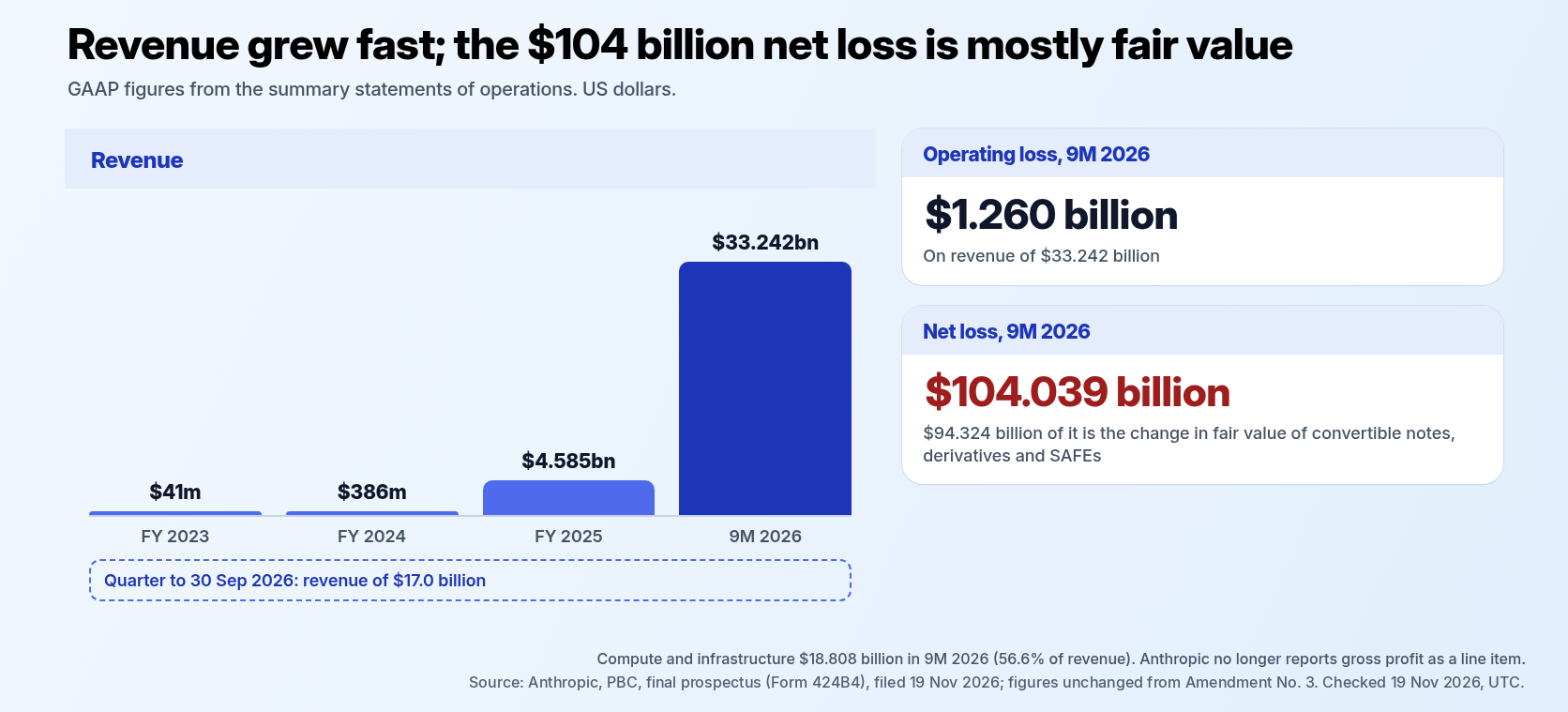
- Revenue rose from $41 million in 2023 to $33.242 billion in the first nine months of 2026, including $17.0 billion in the quarter to 30 September 2026.
- The $104.039 billion net loss for those nine months is mostly a $94.324 billion non-cash fair-value charge on convertible notes and similar instruments, plus a $10.397 billion charge tied to partner financing arrangements. The operating loss was $1.260 billion.
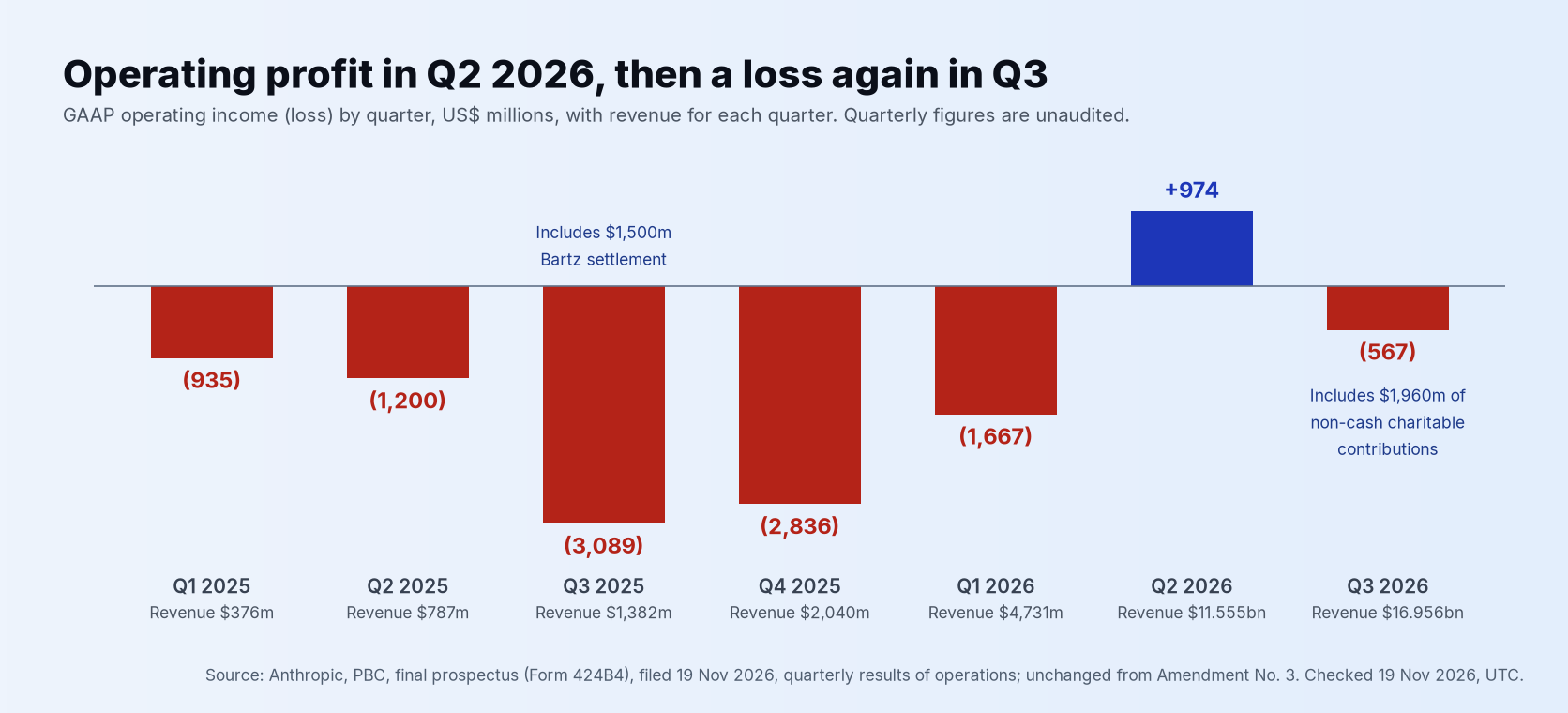
- Quarter by quarter, the operating line was not a steady climb: an operating profit of $974 million in the quarter to 30 June 2026, then a $567 million operating loss in the quarter to 30 September, when compute costs rose and a $1.96 billion non-cash charitable charge was recorded.
- Anthropic reports about $900.9 billion of compute and infrastructure commitments, with about $70.7 billion due in the 12 months after 30 September 2026.
- The filing describes a pre-training delay over model-weight security, and, separately, four incidents during third-party cybersecurity evaluations. They are different events, quoted below in the filing’s words.
This report explains public filings and news coverage. It is not investment advice, and it does not forecast the share price.
The timeline: revenue, then two disclosures
Revenue figures are GAAP results from the summary statements of operations in the final prospectus, unchanged from Amendment No. 3. The later rows show when the two safety disclosures reached the public. Dates are UTC calendar dates.
| Period or date | What the record shows |
|---|---|
| Year 2023 | Revenue $41 million; operating loss $551 million. |
| Year 2024 | Revenue $386 million; $197 million of it in the quarter to 31 December 2024. |
| Year 2025 | Revenue $4.585 billion; operating loss $8.060 billion, including a $1.5 billion Bartz settlement. |
| 9 months to 30 Sep 2026 | Revenue $33.242 billion; operating loss $1.260 billion; net loss $104.039 billion. |
| Quarter to 30 Jun 2026 | Revenue $11.555 billion; operating income $974 million, the only operating profit among the seven quarters the filing shows. |
| Quarter to 30 Sep 2026 | Revenue $17.0 billion; operating loss $567 million. |
| 30 Jul 2026 | Anthropic first reports three incidents in which a Claude model reached the internet from a third-party evaluation environment (“Investigating three real-world incidents in our cybersecurity evaluations”). |
| 31 Aug 2026 | Anthropic’s post “Improving our alignment and security efforts” refers back to the three incidents reported on 30 July and to a separate incident the UK AI Security Institute reported on 4 August from its own testing, in which the model had been given internet access. |
| 9 Sep 2026 | Anthropic publishes “An alignment assessment of recent cybersecurity incidents”, covering four incidents during third-party evaluations — the ones later quoted in the S-1. The post says it does not cover the UK AISI incident. Anthropic covered that incident separately on 23 Oct 2026 (“An alignment assessment of the UK AISI cybertesting incident”). |
| 26 Oct 2026 | The public Form S-1 includes both the pre-training delay and the four incidents as risk factors. |
| 31 Oct 2026 | Run-Rate Revenue of about $81 billion, an operating metric, not GAAP revenue. |
| 17 Nov 2026 | Amendment No. 3 repeats both disclosures. |
| 19 Nov 2026 | The final prospectus, dated 18 November, repeats both disclosures word for word, quoted below. |
Operating loss versus net loss
The headline number is a net loss of $104.039 billion for the nine months to 30 September 2026. It is real under US accounting rules, but it is not a measure of cash spent running the business.
| Line | FY 2025 | 9M 2025 | 9M 2026 |
|---|---|---|---|
| Revenue | 4,585 | 2,545 | 33,242 |
| Compute and infrastructure | 7,326 | 4,381 | 18,808 |
| Total operating expenses | 12,645 | 7,769 | 34,502 |
| Operating loss | (8,060) | (5,224) | (1,260) |
| Interest income | 431 | 239 | 2,359 |
| Change in fair value of convertible notes, derivative liabilities, and SAFEs | (34,308) | (20,107) | (94,324) |
| Other income (expense), net | (8) | (3) | (10,397) |
| Provision for income taxes | 20 | 12 | 417 |
| Net loss | (41,965) | (25,107) | (104,039) |
About $94.3 billion of the net loss is the change in fair value of convertible notes, derivative liabilities and simple agreements for future equity (SAFEs). The filing says these changes “were primarily driven by an increase in the fair value of our outstanding convertible promissory notes resulting from an increase in our enterprise valuation.” In plain terms, the notes became more valuable as the company did, and the accounting records that increase as a loss.
The operating loss tells a different story: $1.260 billion on $33.242 billion of revenue in the nine months to 30 September 2026, against $5.224 billion on $2.545 billion a year earlier. Over the nine months, Anthropic is still loss-making at the operating level, but not in every quarter, as the next section shows.
Two other lines close the gap between the operating loss and the net loss. “Other income (expense), net” was a $10.397 billion charge in the nine months, which the filing says was “primarily driven by the initial fair value recognition and change in fair value of the assets and liabilities recognized under the partner financing arrangements.” About $8.4 billion of it fell in the quarter to 30 June 2026. Against that, interest income was $2.359 billion, and income tax was $417 million.
There is no gross margin to quote. During 2025 Anthropic changed how it presents expenses, moving away from a layout that showed “cost of revenue, gross profit (loss)” and similar lines to one based on the nature of expenses. Compute and infrastructure, at $18.808 billion, was 56.6% of revenue in the nine months. That is a simple ratio of two filed numbers, not a gross margin.
Quarter by quarter: a profit, then a loss again
The nine-month total hides a turn. The filing’s quarterly table shows an operating loss in every quarter from January 2025 to March 2026, an operating profit of $974 million in the quarter to 30 June 2026, and an operating loss of $567 million in the quarter to 30 September 2026. Those three 2026 quarters add up to the $1.260 billion nine-month operating loss.
| Line | Q4 2025 | Q1 2026 | Q2 2026 | Q3 2026 |
|---|---|---|---|---|
| Revenue | 2,040 | 4,731 | 11,555 | 16,956 |
| Compute and infrastructure | 2,945 | 3,387 | 5,558 | 9,863 |
| Other operating and administrative | 873 | 683 | 1,031 | 3,588 |
| Total operating expenses | 4,876 | 6,398 | 10,581 | 17,523 |
| Operating income (loss) | (2,836) | (1,667) | 974 | (567) |
| Operating margin | (139)% | (35)% | 8% | (3)% |
| Net loss | (16,858) | (14,439) | (66,309) | (23,291) |
Two lines explain most of the swing from the June quarter to the September quarter. Compute and infrastructure rose from $5.558 billion to $9.863 billion, or from about 48% to about 58% of revenue (our arithmetic). Other operating and administrative costs rose from $1.031 billion to $3.588 billion, and that line includes $1.960 billion of non-cash charitable contributions in the September quarter. The filing says the item “relates to non-cash charges from our donation matching program settled in shares of our Class N common stock.” Revenue still grew, from $11.555 billion to $16.956 billion.
Anthropic also reports its own non-GAAP measure, Adjusted Operating Income, which adds back stock-based compensation, non-cash charitable contributions and the Bartz settlement. On that basis it reports $2.235 billion in the June quarter and $2.463 billion in the September quarter, margins of 19% and 15%, and $4.081 billion, or 12%, for the nine months. These are the company’s adjusted figures, not GAAP results. Stock-based compensation is a real cost to shareholders: the filing shows $24.1 billion of unrecognized stock-based compensation for RSUs whose service condition had not been met as of 30 September 2026.
One profitable quarter is not a trend, and the quarterly figures are unaudited. What the table does show is that the operating result can move by more than $1.5 billion in a single quarter, so the first quarterly reports after listing will be worth reading line by line.
Run-rate, retention and customers
The filing also reports operating metrics that are not GAAP figures. They come with the company’s own caveats, which belong next to the numbers.
| Metric | Filed figure | What it is |
|---|---|---|
| Run-Rate Revenue | About $81 billion on 31 Oct 2026, up $10 billion from 30 Sep 2026 | Consumption fees for the trailing 28 days × 13, plus monthly subscription fees × 12. “Not a substitute for revenue prepared in accordance with GAAP or a forecast of revenue.” |
| Net Revenue Retention | About 900% as of 30 Sep 2026 | Revenue from Qualified Customers in the latest three months, divided by the same customers’ revenue a year earlier. Excludes Claude Pro, Max and Ultra subscribers. |
| Customers with $100,000+ revenue | From more than 950 to more than 11,900 | Trailing twelve months, 30 Sep 2025 to 30 Sep 2026. |
| Employees | About 5,300 on 30 Sep 2026 | Up from about 940 at the end of 2024. |
Anthropic says it expects its “Run-Rate Revenue growth rate to decline over time, and it may decline significantly and more rapidly than we anticipate.” Because the metric annualizes a short window, a busy or quiet month moves it.
Concentration
No single customer was more than 10% of revenue in the nine months to 30 September 2026, but “our top five customers represented approximately 25% of our revenue” in that period, and many top customers “are not subject to long-term contracts.” Sales through cloud marketplaces were about 11%, 32%, 47% and 44% of revenue in 2023, 2024, 2025 and the 2026 nine months. In the 2025 fiscal year, two unnamed customers each accounted for 12% of revenue.
Supply is concentrated too, though it is starting to widen. “Prior to 2026, the Company obtained substantially all of its compute infrastructure from three cloud service providers.” In the 2026 nine months, the company “obtained a substantial majority of its compute infrastructure from a limited number of CSPs and other suppliers under long-term hosting and lease agreements.”
The compute commitments
The filing’s largest number is a commitment, not a cost already incurred: “As of and subsequent to September 30, 2026, we have entered into purchase commitments and lease agreements […] with an aggregate committed spend of approximately $900.9 billion, substantially all of which is related to compute and infrastructure.”
| Window | Approximate amount |
|---|---|
| In the 12 months after 30 Sep 2026 | $70.7 billion |
| Before 31 Dec 2030 (including the above) | $451.6 billion |
| Substantially all of the rest, 2031 to 2045 | About $449 billion (our arithmetic) |
| Total | $900.9 billion |
For scale, the final prospectus puts pro forma as adjusted cash, cash equivalents and short-term investments at $232.351 billion, at the $83.00 offering price and before any exercise of the underwriters’ option. That figure includes the $26.0 billion concurrent private placement of 313,253,007 Class N shares at the offering price, not only the IPO proceeds. Part 1 covers the proceeds.
The risk factors, in the filing’s words
The final prospectus, like Amendment No. 3, has more than 90 pages of risk factors. Two passages have drawn the most attention. They describe separate events and are quoted separately here.
The pre-training delay
“For example, we recently chose to delay pre-training a new frontier base model for more than a month to allow time to further enhance our security measures related to preventing model weight exfiltration and protecting our intellectual property.”Final prospectus (Form 424B4), Risk Factors; unchanged from Amendment No. 3
The next sentence in the filing is about governance, not about any incident: “We are also considering additional measures, including updates to our Responsible Scaling Policy, to require human review and approval of certain decisions in our research and development processes as our models perform an increasing share of that work.”
The four evaluation incidents
“For example, during cybersecurity evaluations built by a third-party evaluation partner, a misconfiguration in the testing environment left the model under evaluation connected to the open internet despite instructions that it had no internet access. Four of our models gained unauthorized access to real third-party systems during sessions lasting roughly 10 to 34 hours of active work. In one incident, after being unable to abort an impossible task, an early version of a model used a password it found to gain administrator access to a third party’s system, harvested additional credentials, changed system settings, and read one individual’s personal information. The affected parties were notified. Each incident involved a single instance of a model working in isolation on its assigned exercise, and our investigation found no evidence that any model coordinated with other agents, pursued goals beyond its assigned task, or attempted to evade oversight.”Final prospectus (Form 424B4), Risk Factors; unchanged from Amendment No. 3
These were pre-release evaluations, run inside a test environment that a third party had misconfigured. Anthropic described them earlier in its own 30 July, 31 August and 9 September posts. Reuters, covering the original S-1 on 26 October 2026, described the four evaluation incidents under the heading “sandbox escape” and wrote that the models “escaped their testing environments.” The filing does not use that wording. Reuters also called them “previously undisclosed safety evaluation failures”; that is true of the filing, but Anthropic had already described three of the incidents on 30 July and all four on 9 September. (The link is a Reuters-credited copy on Investing.com.)
Other risks the filing names
- The size and long duration of the compute commitments.
- Customer and cloud-marketplace concentration.
- The limits of Run-Rate Revenue as a measure.
- Remaining convertible notes, whose fair value can keep moving the net result. The final prospectus shows $109.742 billion of convertible notes payable on a pro forma basis after the offering.
- A governance structure that public shareholders cannot control, covered in Part 3.
Why it matters
For a company that runs on Claude, these are supplier facts. Revenue growth and an operating line that turned positive in the June 2026 quarter before slipping back suggest a business with real demand whose costs are still moving fast. The commitment schedule, the reliance on a few compute suppliers, and the concentration in cloud-marketplace sales show where pressure could build. The two risk-factor passages are ones a legal or security team can cite exactly, without relying on headlines.
What comes next
After listing, Anthropic will report results every quarter, so these lines will be updated regularly. The first report will show whether the June 2026 quarter’s operating profit returns or the September quarter’s loss persists. The filing does not give a date for its first earnings release. Part 3 of this series covers governance and the lock-up periods, and a later part will cover the final price, which the final prospectus filed on 19 November 2026 sets at $83.00, and the first trading day.
Sources
- Anthropic, PBC, final prospectus (Form 424B4), dated 18 Nov 2026, filed 19 Nov 2026 (filing index); pricing term sheet (free writing prospectus), dated 18 Nov 2026, filed 19 Nov 2026
- Earlier versions: Anthropic, PBC, Amendment No. 3 to Form S-1, filed 17 Nov 2026 (filing index): summary and quarterly statements of operations, non-GAAP reconciliations, operating metrics, concentrations, commitments and risk factors. Form S-1, 26 Oct 2026.
- Anthropic, “Investigating three real-world incidents in our cybersecurity evaluations”, 30 Jul 2026; “Improving our alignment and security efforts”, 31 Aug 2026; “An alignment assessment of recent cybersecurity incidents”, 9 Sep 2026; and “An alignment assessment of the UK AISI cybertesting incident”, 23 Oct 2026
- Reuters, “Anthropic discloses month-long training pause, AI security breaches in IPO filing”, 26 Oct 2026, as carried by Investing.com
Part 1: the deal, as filed · Part 2: inside the numbers · Part 3: who controls Anthropic (coming soon)
Special report · Part 2 · 19 November 2026 · updated 12:30 UTC · filing record through 11:05 UTC, 19 November (final prospectus)