Use Claude Fable 5.2 on the right jobs
Anthropic still recommends starting everyday work on Opus 5.5. Here's when Fable 5.2 is the better pick, and how to run it.

Introduction
On 9 November 2026, Anthropic released Claude Fable 5.2 (model id claude-fable-5-2). Mythos 5.2 is the same underlying model with more permissive cyber and biology safeguards, for organizations in Anthropic’s Cyber or Life Sciences Verification Programs.
Official Platform docs, re-checked on 15 November 2026 (UTC), list Fable 5.2 as Active (latest), with retirement not sooner than 9 November 2027 — a not-before date, not a scheduled end. Anthropic still tells most users to start with Claude Opus 5.5 for everyday coding and knowledge work, and to use Fable for the most ambitious, open-ended technical work, or as an Advisor or Orchestrator.
The six jobs below are from accounts Anthropic published, not our tests. Launch recap: Weekly Edition of 14 November 2026.
1. Who can use Fable 5.2
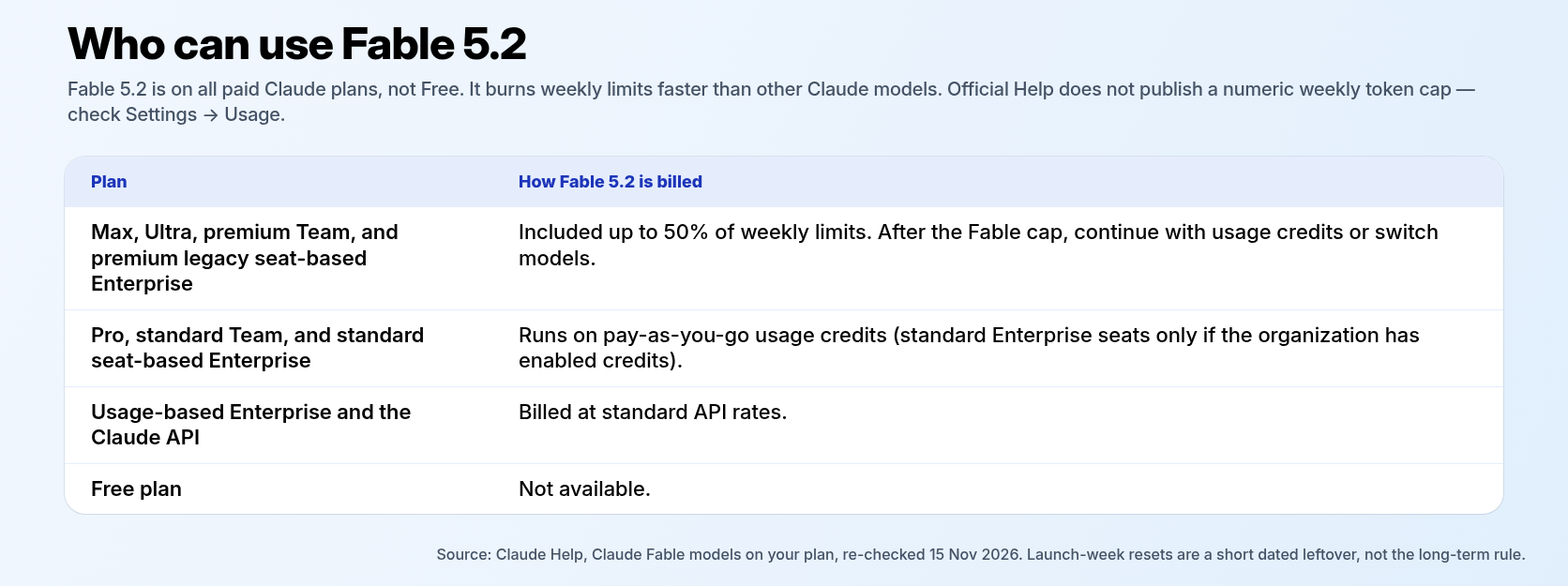
Claude Help says Fable 5.2, 5.1, and 5 “are available on all paid plans (Pro, Max, Ultra, Team, and Enterprise)” and “aren’t available on the Free plan.” Figure 1 is the durable split — standard Enterprise seats get credits only if the organization has enabled them.
Fable draws from the same weekly limits and, Help says, “use[s] them faster than other Claude models.” Help does not publish a numeric weekly token cap — check Settings → Usage (Help’s path; we did not re-check that label in a live app). Verified Ultra has no five-hour limit.
Official surfaces include Claude on the web, Claude Mobile, Claude Desktop, Claude Cowork, Claude Code, Claude Design, Claude for Microsoft 365, and Claude Tag. On the web, Desktop, and Mobile, select Fable 5.2 from the model picker — the default does not auto-switch. Claude Code needs version 2.1.321 or later; Cowork needs the latest Claude Desktop. Developer platforms include the Claude API, Amazon Bedrock, Google Cloud, and Microsoft Foundry.
On Team and Enterprise, an owner controls which models are available. On Enterprise, Fable 5.2 stays off until an admin enables it. Claude Help says that seven days after the 9 November 2026 launch, it is added to every role that has any Fable model enabled, and any default set to a Fable model moves to Fable 5.2, unless an admin opts out first. Help does not give a timezone for that auto-add.
Microsoft said on 11 November 2026 that Fable 5.2 “is now rolling out” in Copilot Cowork and Copilot Studio for eligible users. “Admins stay in control” in the Microsoft 365 admin center, and “availability may vary by region and organization.”
Launch leftover, not the long-term rule: unused Fable limit resets for eligible Max, Ultra, and premium seats expire 9 March 2027, 07:59 UTC. Paid billing (and, for Team or Enterprise, the seat join) had to be in place before 9 November 2026, 18:00 UTC.
2. Pricing, speed, and limits
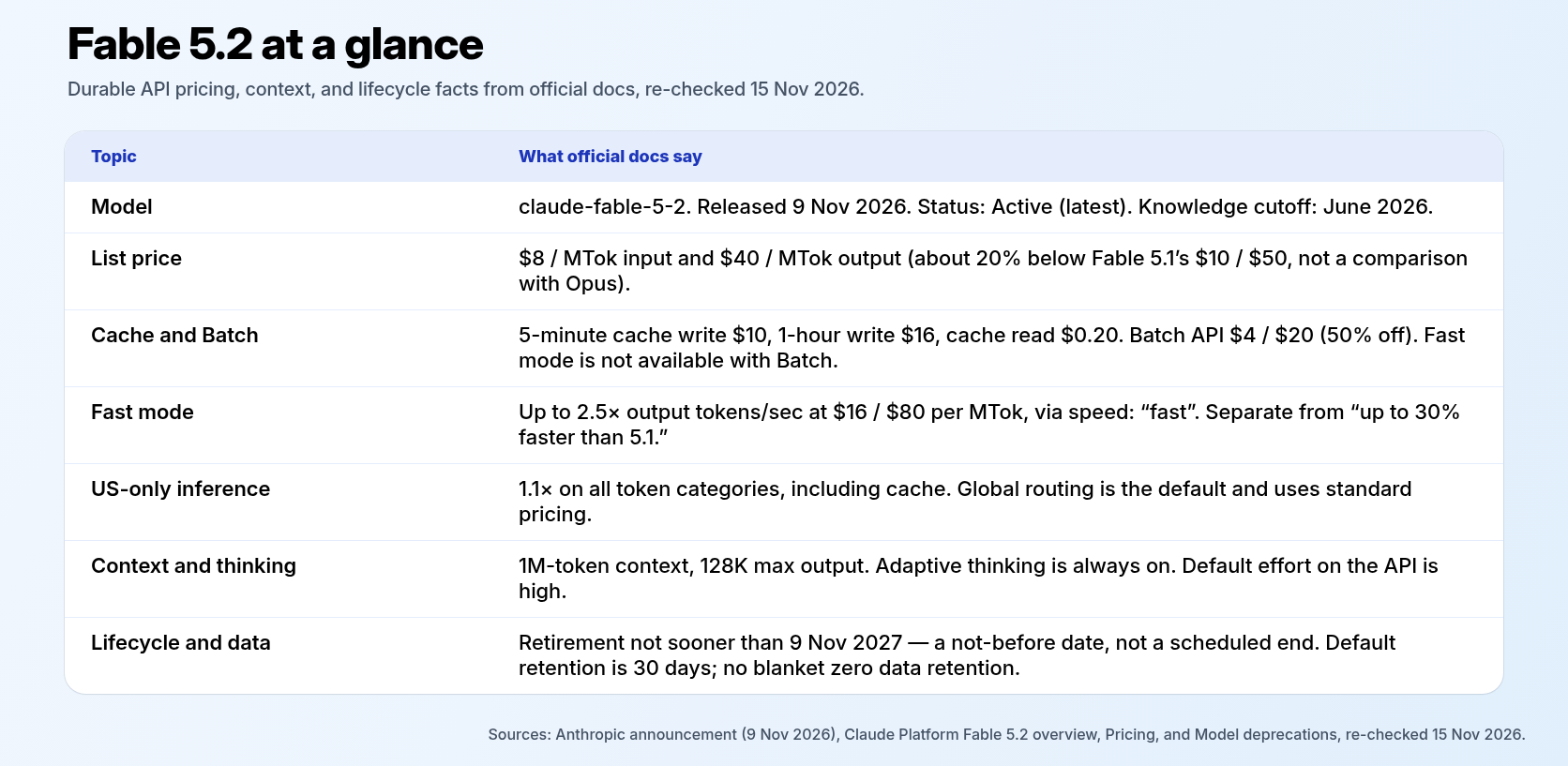
The API list price is $8 / million input tokens and $40 / million output tokens — about 20% below Fable 5.1’s $10 / $50, not a comparison with Opus 5.5 ($4 / $20). Prompt cache is $10 for a 5-minute write, $16 for a 1-hour write, and $0.20 to read. The Batch API is 50% off at $4 / $20. US-only inference (inference_geo: "us", or Foundry US Data Zone Standard) is 1.1× on all token categories, including cache; global routing is the default at standard pricing.
Anthropic says outputs come up to 30% faster than Fable/Mythos 5.1. That is separate from optional fast mode: up to 2.5× output tokens per second at $16 / $80 via speed: "fast", on the Claude API, Claude Code, Claude Models on Google Cloud, and Microsoft Foundry (Anthropic hosted). Fast mode is not available with Batch, and Mythos fast mode is only for Verification Program organizations. Do not treat it as included plan usage.
Context is 1 million tokens (128K max output). Adaptive thinking is always on; control depth with effort (API default high). Knowledge and training-data cutoff: June 2026. Input is text and images; output is text.
3. Official strengths and cautions
Anthropic positions Fable 5.2 as its most capable generally available model for ambitious software engineering, and as its “strongest lead agent.” Those claims are Anthropic’s; we have not reproduced them.
Fable blocks high-risk cyber work (including penetration testing, exploit generation, and binary-based vulnerability work) and most research-biology tasks. Flagged cyber queries fall back to Opus 4.8; biology queries fall back to Opus 5. Anthropic reports about 55% fewer unnecessary blocks than Fable 5.1 in early testing, but the blocks remain. Teams with legitimate work in those domains should apply for Mythos through the verification programs. Claude Enterprise customers can use Claude Security, which can be powered by Mythos 5.2.
Do not overclaim every benchmark. On Anthropic’s own AutomationBench table, Gemini 4 Carbon is ahead of Fable 5.2 (53.9% vs 51.4%). On AA-Briefcase v1.1 Elo, Opus 5.5 is slightly ahead (1800 vs 1785), even though Fable leads the rubric score. Fable and Mythos 5.2 also require 30-day data retention by default, with no blanket zero data retention unless Anthropic expressly authorizes it (the Enterprise Frontier Safeguards path, described as private beta). Partner-operated platforms such as Bedrock or Google-managed endpoints may set their own retirement schedules.
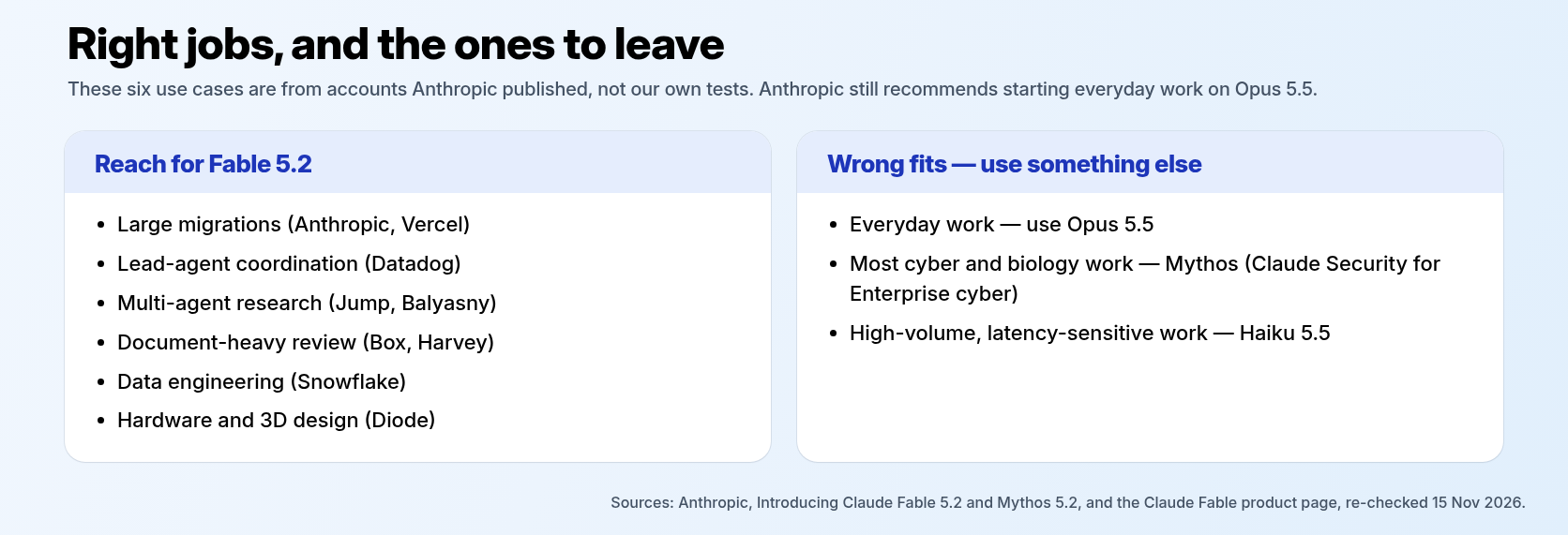
4. Six jobs from accounts Anthropic published
Large migrations
Anthropic says Fable 5.2 will question inherited conclusions and test its own work, and that a team of agents running an earlier version of Fable 5.2 migrated a production service from Python to Rust. Vercel’s Joe Haddad is quoted saying projects that had been pushed along with other models for weeks were finished and approved in a few days.
Lead-agent coordination
The product page calls Fable 5.2 Anthropic’s “strongest lead agent,” able to run ambiguous engineering work for days and coordinate hundreds or more than a thousand subagents. Datadog’s Matt Lee is quoted describing it as “almost like an incident commander that can send out faster models to get quick signals and coordinate.” Anthropic’s eight-day operating-system experiment (more than 1,000 subagents, starting from an empty folder) is an official demonstration, not a reader template.
Multi-agent research
Jump Trading’s Lucas Baker is quoted on Fable 5.2 playing “every major role within a research system” and, in an internal benchmark, a “full 10% lower error than the next best model.” Balyasny’s Ashish Malik is quoted on a test in which it traced sources, did not overstate the evidence, and flagged a misleading question frame. Those are firm-reported evaluations published by Anthropic, not our scores.
Document-heavy review
Box’s Yashodha Bhavnani describes a loan-application review in which Fable 5.2 flagged that salary deposits and the bank-statement balance did not match. Harvey’s Niko Grupen describes clearer direction than Fable 5.1 in an I-9 compliance review. These are reported customer tests, not legal or credit advice.
Data engineering
Snowflake’s Bala Kasiviswanathan is quoted saying Fable 5.2 was the strongest model they measured on data-eng-bench (103 tasks), “solved tasks consistently across repeated runs and passed every interactive coding task we gave it.” That is Snowflake’s benchmark, published by Anthropic, not a public leaderboard we re-ran.
Hardware and 3D design
Anthropic says Fable 5.2 is its best model for designing objects for the real world and on screens. In an official collaboration with Diode, it designed three working devices from a one-paragraph prompt — a voice-assistant hub, a USB speakerphone, and a handheld virtual pet. Each four-layer board was ready for manufacturing in under a day, and all three worked without electrical modifications after Diode built them. That official example does not mean every reader will get the same result.
5. Three jobs Fable is the wrong fit for
Everyday coding, drafting, and most knowledge work. Start with Opus 5.5, Anthropic’s “strongest daily driver,” and only move up when Opus at higher effort still falls short. Fable also costs more at the API ($8 / $40 vs Opus $4 / $20).
Most cybersecurity and research-biology work. Officially, Fable’s safeguards “will block most cybersecurity-related tasks,” and flagged biology queries are routed to Opus 5. Use Mythos 5.2 through the Cyber or Life Sciences Verification Program, or Claude Security on Claude Enterprise, for legitimate work in those domains.
High-volume, latency-sensitive chores (classification, extraction, routing): the official models overview points to Claude Haiku 5.5, not Fable.
6. How to run a Fable 5.2 job
Use Fable only for ambitious, multi-step, or high-judgment work; leave routine edits on Opus 5.5. Choose Fable 5.2 in the model picker — it does not auto-switch — and in Claude Code use version 2.1.321 or later. Ask for a phased plan, risks, and a rollback, then implement one phase with tests. Watch Settings → Usage (Fable burns weekly limits faster) and budget Fast mode at $16 / $80 separately.
Three starter prompts (ours, not Anthropic’s)
We have not run them.
Migrate this service to the new package layout. First produce a phased plan with risks and a rollback. Then implement phase 1 with tests that prove the old callers still work.Review this document set. Flag inconsistencies across files, separate facts in the sources from your inferences, list what a human should verify next, and name anything you could not confirm from the files alone.Run a research pass on this question. Separate facts found in the sources from your inferences, list unknowns, and propose the next three checks a human should do. Do not overstate the evidence.What Anthropic suggests
Official Fable 5.2 system-prompt lines from Prompting Claude Fable 5.2 (fetched 15 November 2026, UTC) — Anthropic’s suggested lines, not user-job starters like ours, and not prompts we have run. Treat them as a starting point and adapt them.
On effort, the same page says: “Start at high, the default for Claude Fable 5.2 on the Claude API.” It also says: “medium suits interactive coding, chat, and everyday knowledge work.” And: “high suits hard coding, research, agentic work, and long unattended runs. Turns take noticeably longer to finish than at medium.”
From Prompting Claude Fable 5.2: “If you see these stops in your agent, add text like this to your system prompt:”
# Finishing work
Please avoid stopping while you still owe work the user asked for. Be persistent and do not stop unless needed.

While status notes are welcome, as is clarifying with the user on open decisions, carry on with work that does not depend on the user's answer without unnecessary stops.

If you notice yourself inviting the user to redirect you or offering to wait, instead proceed on the next part of the task. You may meet ordinary obstacles like errors, timeouts, locked files, empty results or failing tools. Diagnose them first, and when they are not real blockers, work through them with the access you have (wait and retry, fix the request, use another tool or source) rather than stopping unnecessarily.

If someone clearly decided something is a hard blocker, such as a file marked not to be touched, access that was intentionally withheld, or a safety guardrail, leave it alone, say plainly what you found, and look for another safe way to finish the task. Stopping before the task is complete is very rarely merited, as in when the task can't move forward without user input, or where the blocker is deliberate and should not be worked past. This does not override the need for confirmation on risky or destructive actions.
In Anthropic’s medium tests, a version of this text cut unfinished-but-continuable endings by about half and raised output tokens by about 30 percent. Because the model asks less often with this text, keep your own confirmation step for risky or irreversible actions. This does not override our migration starter, which still stops after a plan plus phase 1.
From Prompting Claude Fable 5.2: “When you ask the model to keep going, say exactly what you want rather than sending a simple “continue.” For example, reply “Yes, run the migration on the staging database” where you might have sent a “go” or a thumbs-up.”
Yes, run the migration on the staging databaseFrom Prompting Claude Fable 5.2: “If you ask Claude Fable 5.2 to write final reports or handoffs, add this text to your system prompt, and adjust it to your readers and your product:”
# Communicating clearly
Write for an intelligent but low-context reader. The person reading has not seen your tool calls, your reasoning or the files you opened, and may be switching in from other work. Messages should generally be self-contained: the reader should understand what you mean without having to dig for other context. Put the key points in the first few sentences. Practice progressive disclosure in your sentence order, and do not use undefined references and ideas in line 1 that won't make sense until the reader reaches line 12.

Use plain words, and write in clear, understandable full sentences. Do not use a term or abbreviation that you made up during the work. Say what the thing is in a way any reader would understand. Write mostly in the style of ASD-STE100 Simplified Technical English: short sentences, one idea per sentence, active voice, and consistently using the same word for the same thing. Use a paragraph of flowing prose where ideas connect, and keep bullets for lists of separate items. Leave out unnecessary details unless the reader asks and practice concision, but do ensure that your messages have the key context. Aim to make your user-facing text as human-readable and clear as possible.
From Prompting Claude Fable 5.2: “If you want the model to improve the structure as it works, say that the code is its own:”
You are the owner and long-term maintainer of this codebase, and its design is up to you.Do not add that ownership sentence to our migration starter, and leave it out where the user owns the code and wants it changed as little as possible. With this prompt, output tokens rose by about 70 to 80 percent and the model made changes nobody had asked for, many of them new tests and documentation. In some runs, it also changed how an existing feature behaves. A rule that limits scope doesn’t cancel it: in Anthropic’s testing, the model still consolidated duplicated code in more than half of runs when “No drive-by refactors, renames or cleanups” appeared earlier in the same prompt. A closing PR summary from Claude Fable 5.2 often left out small changes, so review the reported diff and the summary.
Conclusion
Start everyday work on Opus 5.5, and reach for Fable 5.2 when the job is ambitious, open-ended, and high-judgment. Official docs, re-checked on 15 November 2026 (UTC), list it as Active, with retirement not sooner than 9 November 2027.
Resources
- Introducing Claude Fable 5.2 and Mythos 5.2 → anthropic.com
- Claude Fable product page → anthropic.com/claude/fable
- Claude Fable models on your plan → support.claude.com
- Claude Fable 5.2 overview → platform.claude.com
- Prompting Claude Fable 5.2 → platform.claude.com
- Pricing → platform.claude.com
- Model deprecations → platform.claude.com
- Claude Fable 5.2 in Microsoft Copilot (11 November 2026) → techcommunity.microsoft.com
- Weekly Edition, 14 November 2026 (launch recap) → AI Productivity Insights
- The Rise of AI Bots (Fable 5.1 pricing, not 5.2) → AI Productivity Insights