Put Gemini 4 Hydrogen to Work on Your Daily Tasks
Google launched gemini-4-hydrogen on 12 Nov 2026 as its fast Gemini 4 model for everyday coding and agent work, with a free API tier and a flat $1.50 / $7.50 paid price. It is rolling out globally — not a claim that it is already everywhere at once.
Introduction
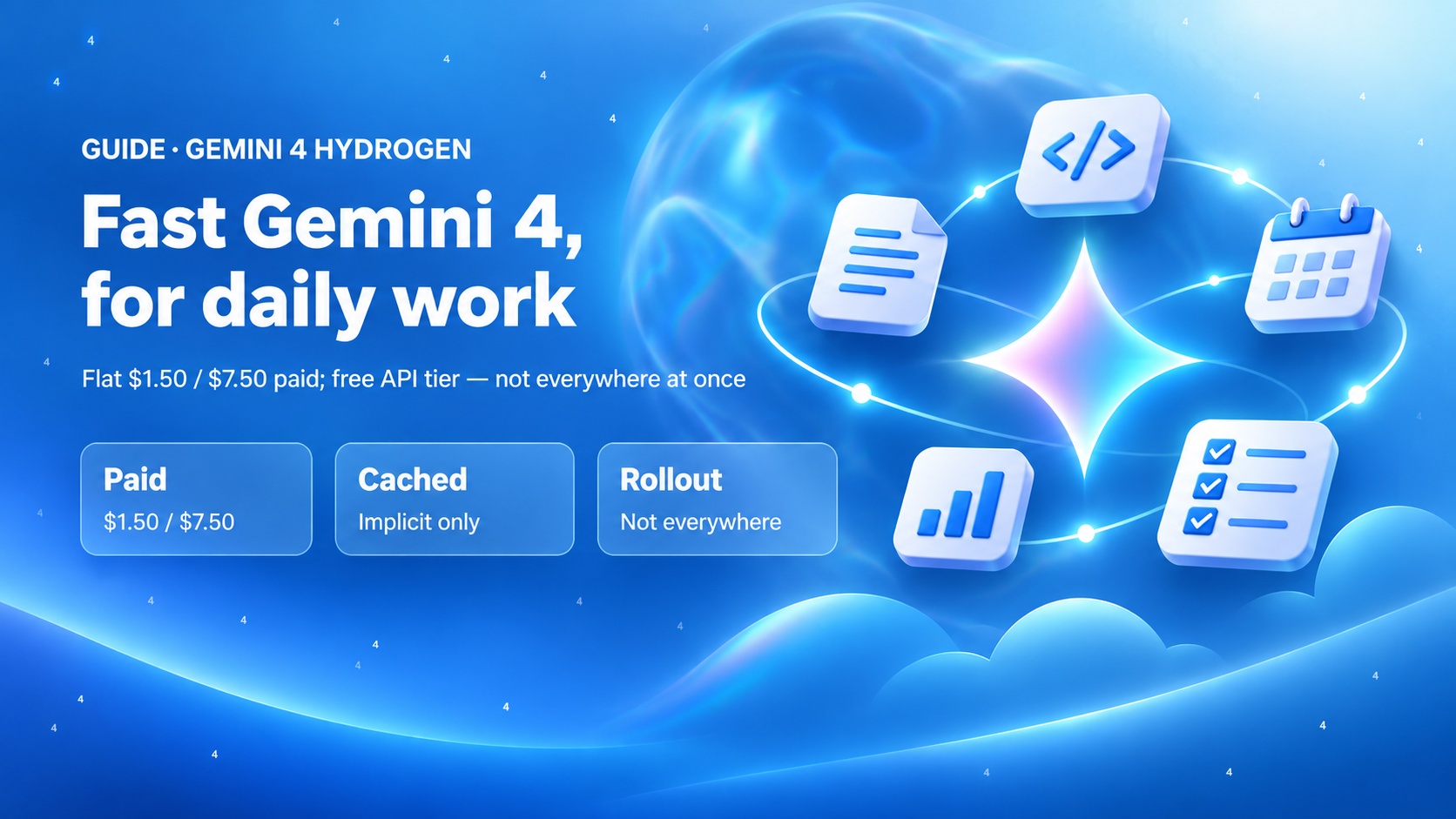
On 12 Nov 2026, Google introduced Gemini 4 Hydrogen as the model it wants you to reach for when the job is rapid execution — everyday coding and agentic workflows — either on its own or as the execution engine next to Gemini 4 Carbon or Argon. The paid API list is a flat $1.50 input / $7.50 output per million tokens across a unified 1-million-token window, and there is an official free tier (rate-limited). We did not run a bake-off; this is a documented map of where it is, what it costs, and which nearby deadlines actually affect it.
- Paid list: $1.50 / $7.50 per 1M tokens, flat across the 1M context. Cached input is $0.075 via implicit caching only. Thinking tokens bill as output.
- Not everywhere at once. Antigravity is paid Google AI Pro and Ultra only. In the Gemini app, official Help (re-checked 17 Nov 2026) lets Google AI Plus, Pro, and Ultra subscribers select Hydrogen in chats; free users get it through auto-selection when it is the appropriate model. Official posts do not call it the default for AI Mode.
- 1 Dec is not a switch to Hydrogen. The pricing page now also says
gemini-2.5-proandgemini-2.5-flashare deprecated and no longer available to select in Google AI Studio. From 1 Dec 2026, remaining API requests auto-route togemini-3.8-flashandgemini-3.5-flash-lite, billed at those models’ rates — not to Hydrogen.
1. Where You Can Use It — and Where the Rollout Is Narrower
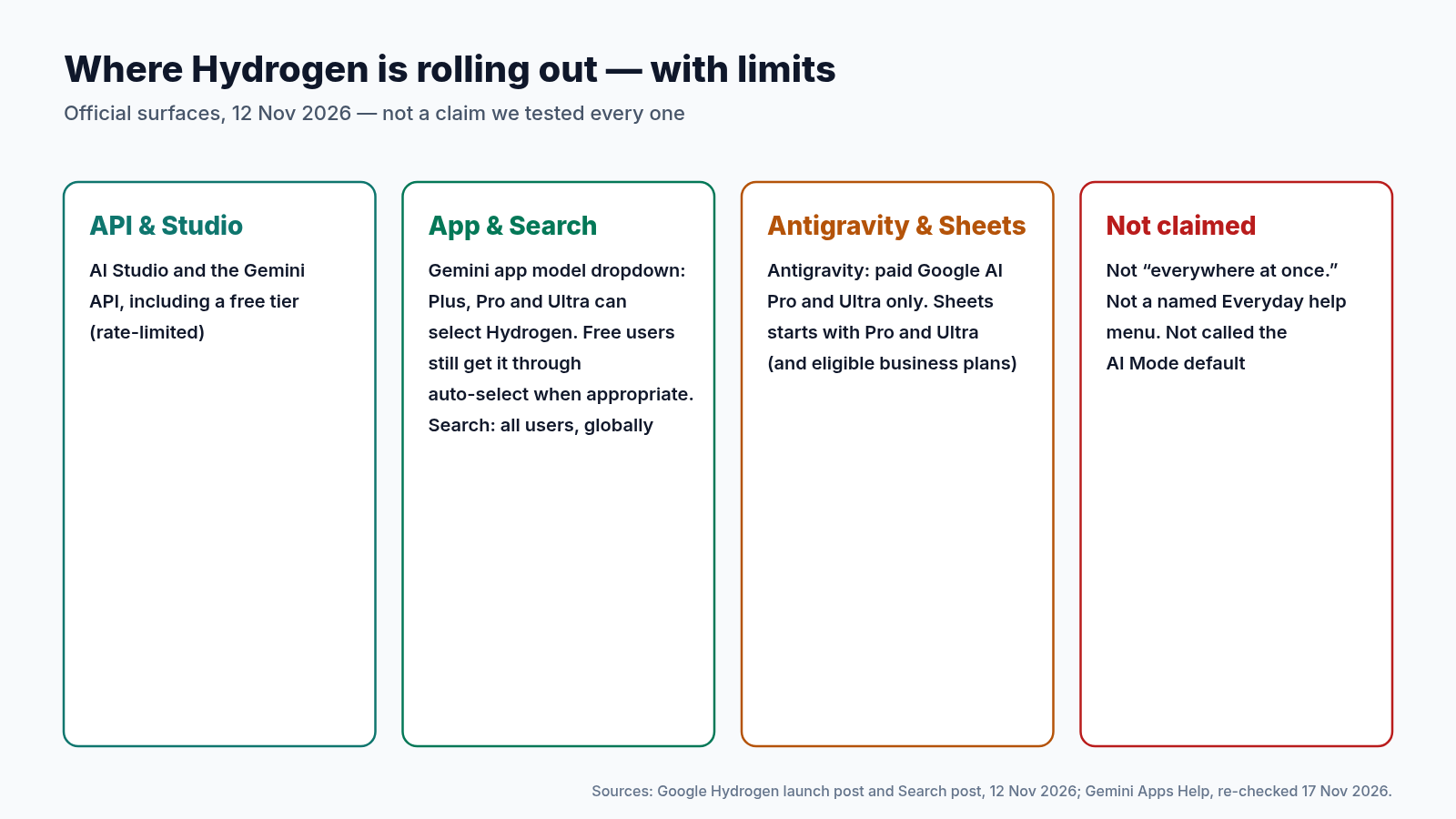
Google describes a global rollout across Google AI Studio, the Gemini API, Gemini for business, the Gemini app, Google Search, and paid Google AI Pro and Ultra in Antigravity. Developers can try it in the Gemini API in AI Studio and Android Studio. Enterprises can use it in Gemini for business (API or the model dropdown), in Antigravity, and as Gemini in Google Sheets for eligible business subscriptions.
For everyone else, the official surfaces are the Gemini app model dropdown and Google Search for all users. Google calls this the biggest model upgrade to Search yet. Official posts do not say Hydrogen is “the default model for AI Mode,” and we are not adding that claim.
The limits already in those official lists are the ones that matter for a default: Antigravity is paid Pro and Ultra only; Sheets starts with Pro and Ultra (and eligible business subscriptions); free Gemini-app users get Hydrogen via auto model selection when it is the appropriate model. That last point is not a claim that every free prompt uses Hydrogen, and it is not a confirmed menu name such as “Everyday help.” Official pages name the model dropdown, plus auto-selection for free users. We have not confirmed the exact dropdown label, or every case in which auto-selection fires, and we are not inventing either.
What official Gemini Apps Help does add, as of a 17 Nov 2026 re-check, is who can select Hydrogen in the Gemini app. On a personal Google Account, chats can use: Flash-Lite or auto-selection with no AI plan; Flash-Lite and Hydrogen on Google AI Plus; Flash-Lite, Hydrogen, Pro, and Argon on Google AI Pro; and Flash-Lite, Hydrogen, Argon, and Carbon on Google AI Ultra. If auto-selection is on and you have no AI plan, Help says most prompts use Flash-Lite, and prompts that need more reasoning may use Hydrogen; if it is off, all responses use Flash-Lite. Official Help: at the bottom of the chat box, click or tap the current selected model, then choose a model. Higher-tier models with a lock icon require an eligible plan upgrade. Auto model selection is turned on or off under Settings > Usage limits. To see which model wrote a reply, Help says to open More at the bottom of the response and choose See response details.
This guide is about everyday work in the app, Search, Sheets, and the API — not a walkthrough of Tasks in Gemini, the official product feature. That feature is listed as available on Pro (Hydrogen, Argon) and Ultra (Hydrogen, Argon, Carbon), and as N/A on Plus and on accounts with no AI plan. A sheet clean-up in Gemini in Sheets still starts with Pro and Ultra (and eligible business subscriptions).
One more Antigravity detail from the official What’s new page, also re-checked 17 Nov 2026: the Antigravity agent in Gemini Managed Agents now uses gemini-4-hydrogen by default (the underlying model can be configured). That does not widen access — trying it in Antigravity is still for paid Google AI Pro and Ultra subscribers, as the launch post states. Official Cloud docs also list gemini-4-hydrogen on Gemini Enterprise Agent Platform (Agent Studio). This guide does not quote a separate Agent Platform or Vertex price list.
2. What It Costs, Including the Cache Fine Print
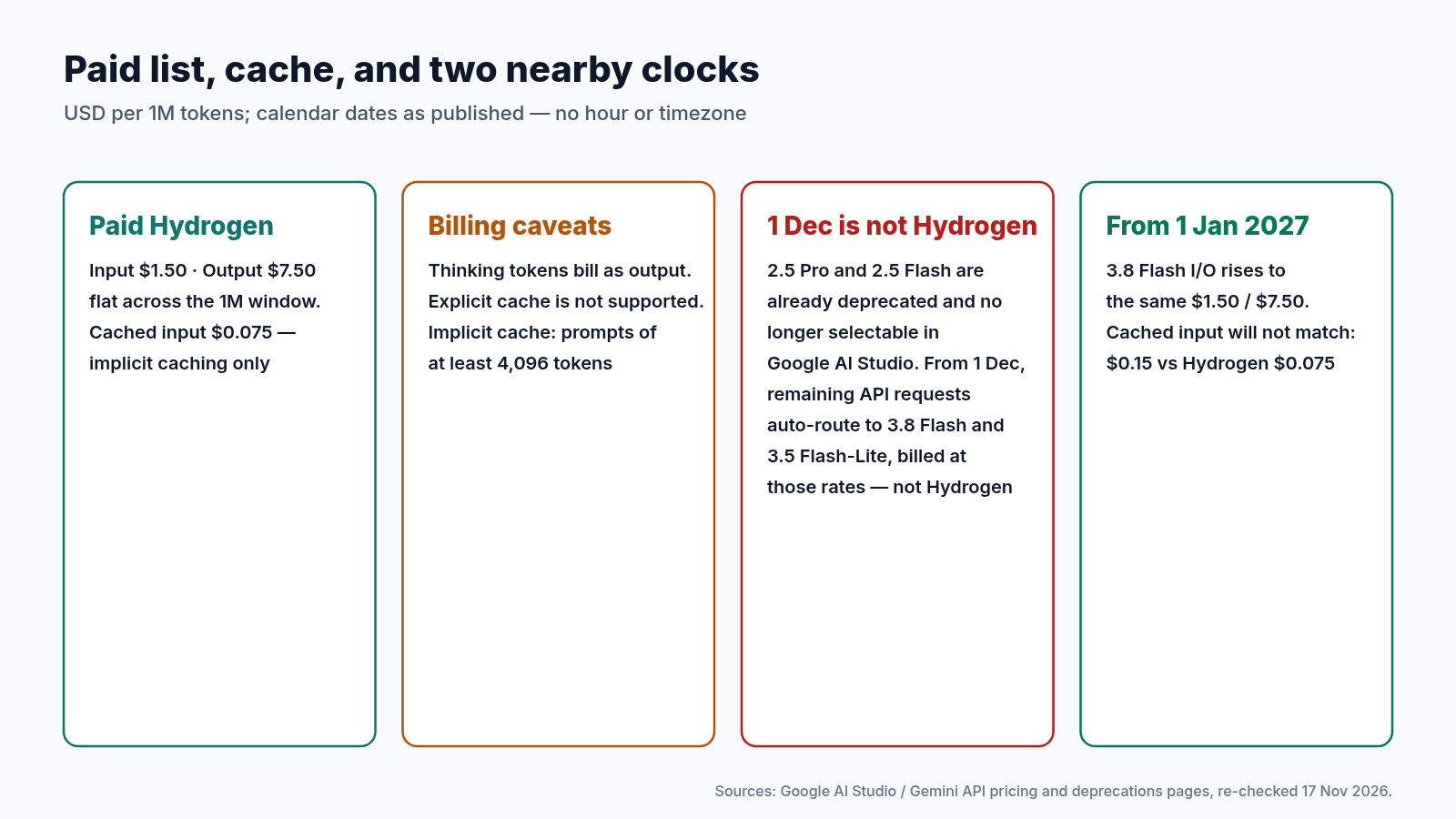
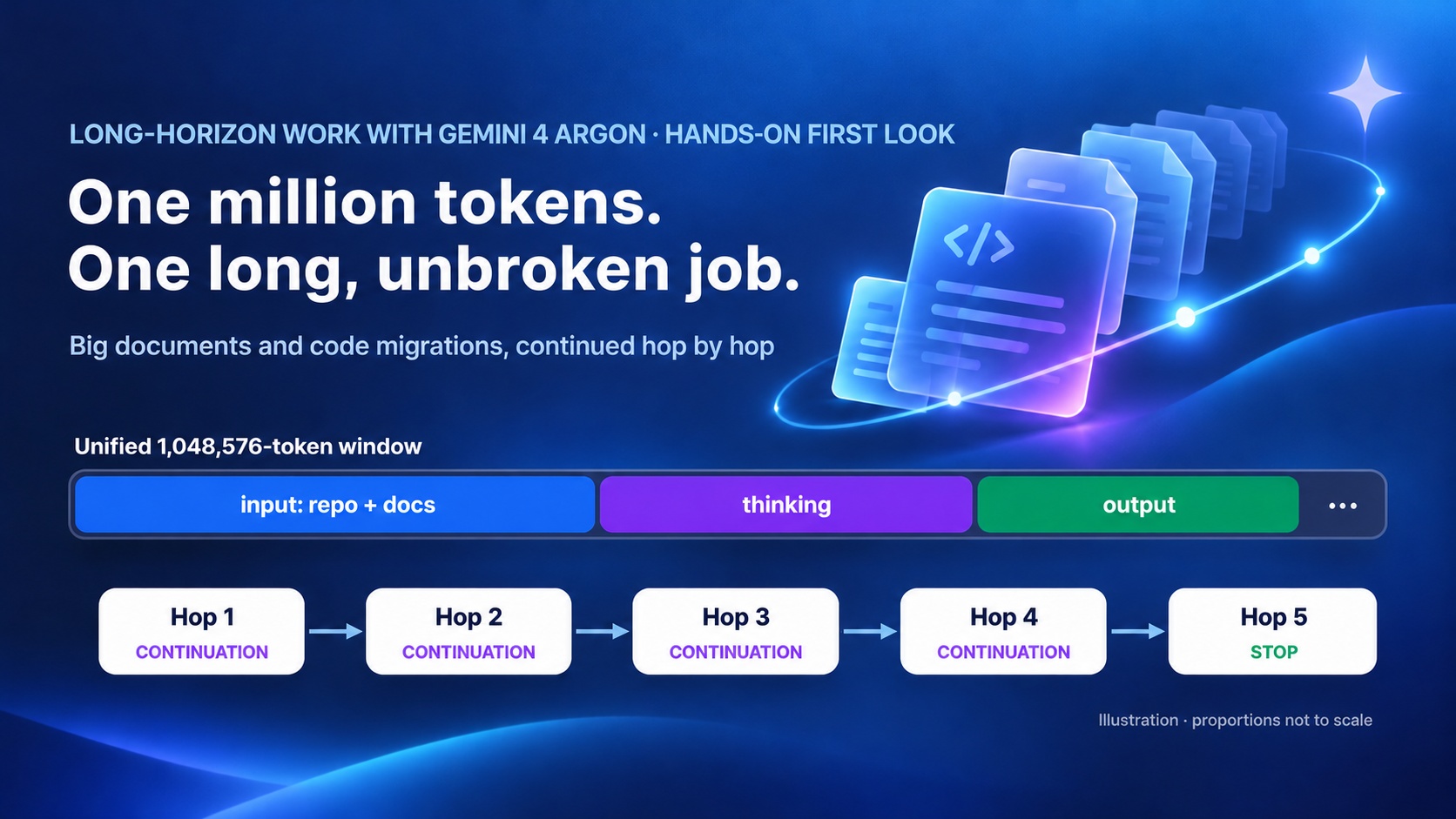
On the Gemini API pricing page (re-checked 17 Nov 2026), paid Hydrogen is $1.50 / $7.50 per million input/output tokens, flat across the unified 1,048,576-token window (input, thinking, and output share that window). Official What’s new: Hydrogen “supports synchronous outputs up to 65,536 tokens and long decode up to the 1M unified context window.” Longer outputs need background execution or continuation, as What’s new in Gemini 4 Hydrogen describes it.
Cached input is $0.075 — a 95% discount — via implicit caching only. Explicit caching (cachedContents / caches.create) is not supported. Implicit caching is documented as applying to prompts of at least 4,096 tokens. Thinking tokens bill as output. Every token the model processes is counted, including internal tool system instructions and function declarations when you use grounding.
On the API and in AI Studio, official What’s new wording is to configure the thinking_level parameter. Hydrogen’s values are low, medium, high (the default), and xhigh. It rejects minimal with an error. If you send sampling parameters such as temperature, top_p, or top_k, the server ignores in-range custom values; out-of-range values return a 400 validation error. In the Gemini app, official Help lists only Low, Medium, and High, and says that if you do not select a thinking level it defaults to Low. We are not claiming the app offers xhigh.
The free tier lists input, output, and context caching as free of charge, but it is rate-limited. We are not publishing a rate-limit number here — official limits depend on your usage tier and can change; check the live rate-limits page, or your limits in AI Studio, before you send a job. Search and Maps grounding are not available on the free tier. On the free tier, content may be used to improve Google’s products; on paid, the pricing card says it is not.
3. When to Stay on Argon or Carbon — and What 1 December Actually Does
Google still positions Carbon and Argon for deep, long-horizon work, and Hydrogen for rapid execution. If a job still needs Gemini 4 Carbon (gemini-4-carbon), budget for its price change: official What’s new in Gemini 4 Carbon calls the current window “introductory pricing,” and Google’s Gemini API pricing lists $2.00 input / $10.00 output per 1M tokens through 30 Nov 2026 and $4.00 / $20.00 starting 1 Dec 2026 (calendar dates as published; no hour or timezone). This post is not a second Carbon explainer.
For API readers who want Hydrogen, change the model id to gemini-4-hydrogen. Do not assume the 1 Dec 2026 auto-route will land you there. The pricing page and the Gemini API deprecations page, re-checked 17 Nov 2026, already say gemini-2.5-pro and gemini-2.5-flash are deprecated and no longer available to select in Google AI Studio. Official deprecations wording: API access is limited to existing users who have actively used those models in the past. Effective 1 Dec 2026, all API requests to those model ids auto-route to gemini-3.8-flash (billed at 3.8 Flash rates) and gemini-3.5-flash-lite (billed at 3.5 Flash-Lite rates). Google also calls Hydrogen the recommended upgrade from 3.8 Flash and earlier 3 / 2.5 models — that is a recommended migrate, not the auto-route destination. No hour or timezone is published for either change.
A second clock is worth a line if you currently use 3.8 Flash on price: until 1 Jan 2027, 3.8 Flash remains cheaper on list ($0.75 / $3.75). From that date, 3.8 Flash paid input/output rises to $1.50 / $7.50 — the same as Hydrogen — but cached input will not match. Hydrogen stays at $0.075; 3.8 Flash goes to $0.15.
The same split carries over to Antigravity coding, where Carbon or Argon can plan and Hydrogen can build in one session.
4. A Reader Checklist — No Scores from Us
We did not run email, spreadsheet, or script trials, so there are no quality or token results to quote. If you want a first-day check, keep it small and write down what you see:
- One email draft, one sheet clean-up, and one short script. A sheet clean-up in Gemini in Sheets still starts with Google AI Pro and Ultra (and eligible business subscriptions).
- Compare quality and tokens yourself, and note whether auto-select picked Hydrogen in the Gemini app. Official Help: at the bottom of a response, open More and choose See response details to see which model was used.
- If you are on the paid API, remember that the $0.075 cache rate is implicit-only.
Google’s own quality and speed claims, from the launch post, need their qualifiers attached. On the Artificial Analysis Intelligence Index, Google says Hydrogen scores 51 vs 50 versus Argon at default high thinking, and 54 at xhigh. Versus Gemini 3.8 Flash, at its high default setting, Google says it finishes tasks 2.5× faster, more than triples Terminal-Bench 4.1 (57% vs 18.2%), and cuts fabricated claims by more than 5×. Those are Google’s figures, not a test we ran.
Common Misconceptions
“Hydrogen is rolling out everywhere at once.” Official language is a global rollout with surface-specific limits. Antigravity is paid Pro and Ultra; Sheets starts with Pro and Ultra; free Gemini-app users get it through auto-selection when appropriate.
“It is the default model for AI Mode.” Official posts say it is available globally in Search for all users, and call it the biggest model upgrade to Search yet. They do not use that default wording.
“From 1 Dec, 2.5 Pro and 2.5 Flash API calls switch to Hydrogen.” Those model ids are already deprecated and no longer available to select in Google AI Studio. From 1 Dec, remaining API requests auto-route to 3.8 Flash and 3.5 Flash-Lite, billed at those models’ rates — not to Hydrogen.
“From 1 Jan 2027, Hydrogen and 3.8 Flash will cost the same in every column.” Input and output will match. Cached input will not: $0.075 versus $0.15.
Conclusion
Hydrogen is the fast Gemini 4 model Google is putting on everyday coding and agent work, with a free API tier and a flat $1.50 / $7.50 paid list. Use it where the official rollout has reached you, keep Argon or Carbon for the long-horizon jobs, and don’t treat 1 December as a Hydrogen migration. If you still rely on Carbon, budget for its 1 December price change.
Resources
- Google: Introducing Gemini 4 Hydrogen for Agentic Workflows (12 Nov 2026) → blog.google
- Google AI Studio / Gemini API pricing → aistudio.google.com
- What’s new in Gemini 4 Hydrogen → aistudio.google.com
- Google Search gets a major upgrade with Gemini 4 Hydrogen (12 Nov 2026) → blog.google
- Gemini Apps Help: About Gemini models (re-checked 17 Nov 2026) → support.google.com/gemini
- Gemini API rate limits → aistudio.google.com
- Gemini API deprecations (re-checked 17 Nov 2026) → aistudio.google.com
- Gemini 4 Hydrogen on Gemini Enterprise Agent Platform → docs.cloud.google.com
Share this with anyone who thinks 1 December auto-routes their 2.5 API calls to Hydrogen.